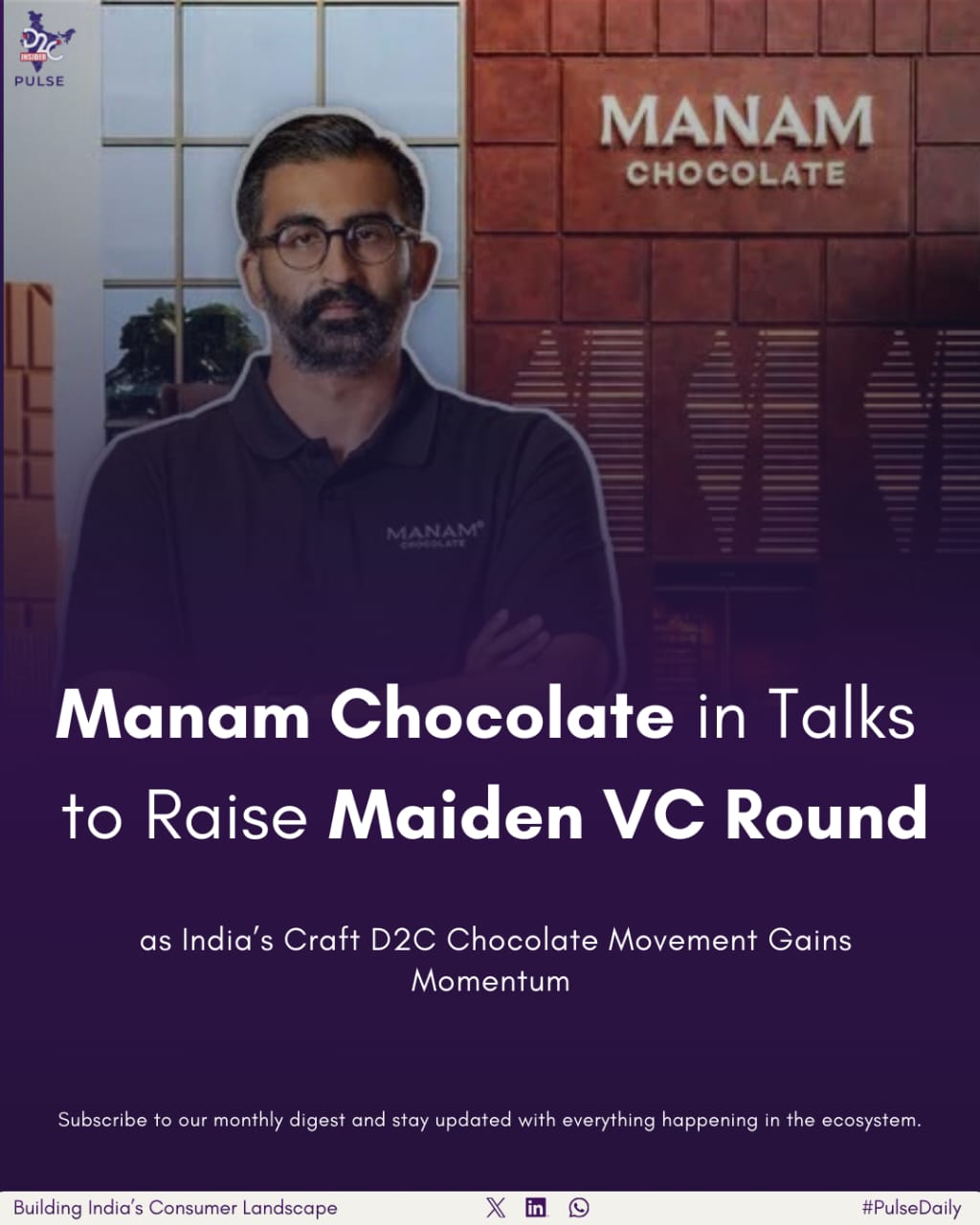
India’s direct-to-consumer ecosystem continues to deepen across food and beverage categories, with premium and craft-led brands increasingly drawing venture capital interest. In a key development within D2C news India, Hyderabad-based craft chocolate brand Manam Chocolate is in advanced discussions to raise its maiden venture capital funding round, with Omnivore emerging as a potential lead investor, according to sources familiar with the matter.
As per industry sources, the funding round is expected to be in the range of $5–10 million, though it could be sized higher if both parties agree that additional capital is required to aggressively scale operations and expand into multiple regions across India. While neither Manam Chocolate nor Omnivore has officially commented on the discussions, the development signals growing investor confidence in differentiated, premium D2C brands India operating at the intersection of food, sustainability, and craftsmanship.
Founded in 2023, Manam Chocolate has rapidly built strong consumer recall in Hyderabad and beyond. The brand’s name—Manam, meaning “We” or “Us” in Telugu—reflects its community-driven philosophy and its deep connection to origin, culture, and shared experience. Unlike conventional mass-market chocolate brands, Manam follows a fully integrated, full-stack model, owning the journey from cacao cultivation to finished chocolate and retail experience.
This vertically integrated approach has become Manam’s defining moat within the D2C ecosystem India. While most Indian chocolate brands source processed cocoa or chocolate compounds, Manam controls cacao farming, fermentation, roasting, and chocolate-making, allowing it to unlock flavour profiles that are typically lost in industrial-scale manufacturing. The brand positions itself as an antidote to mass-produced chocolate, which often prioritises standardisation over taste, provenance, and quality.
Within D2C startup news, Manam’s potential funding round highlights a broader shift in investor appetite toward craft-led, premium food brands with clear differentiation. India’s craft chocolate movement remains at a relatively early stage, largely driven by small-batch bean-to-bar makers. However, many such players operate only at the bean stage and lack control over the cacao fruit itself, limiting flavour development and scalability. Manam’s full-stack cacao-to-chocolate model directly addresses this gap, offering both quality control and long-term brand defensibility.
The timing of this funding discussion also aligns with evolving D2C market trends 2025, where consumers are increasingly willing to pay a premium for authenticity, traceability, and superior taste. Urban Indian consumers, particularly Gen Z and millennials, are moving away from commoditised sweets toward experiential indulgence—creating fertile ground for premium D2C food and beverage brands.
For Omnivore, known for backing agrifood and consumer brands with strong supply-chain integration, Manam Chocolate fits squarely within its investment thesis. A potential partnership would not only provide growth capital but also strategic support across sourcing, sustainability, and expansion—critical levers as Manam looks to scale production, deepen retail presence, and potentially expand into new formats and geographies.
From a D2C business India perspective, the proposed funding would likely be deployed across capacity expansion, wider retail and experiential formats, talent acquisition, and brand building. It could also accelerate Manam’s presence beyond Hyderabad into other major metros, strengthening its position among latest D2C startups redefining India’s premium food landscape.
More broadly, Manam Chocolate’s funding talks underscore how India’s D2C industry news is evolving beyond price-led convenience into value-led indulgence. As consumers seek products with soul, story, and substance, brands that combine control over supply chains with strong storytelling are emerging as attractive bets for venture capital.
If the deal materialises, Manam would join a growing list of VC-backed D2C brands shaping the next phase of India’s consumer internet—where craft, quality, and culture drive scale just as much as distribution and discounts.