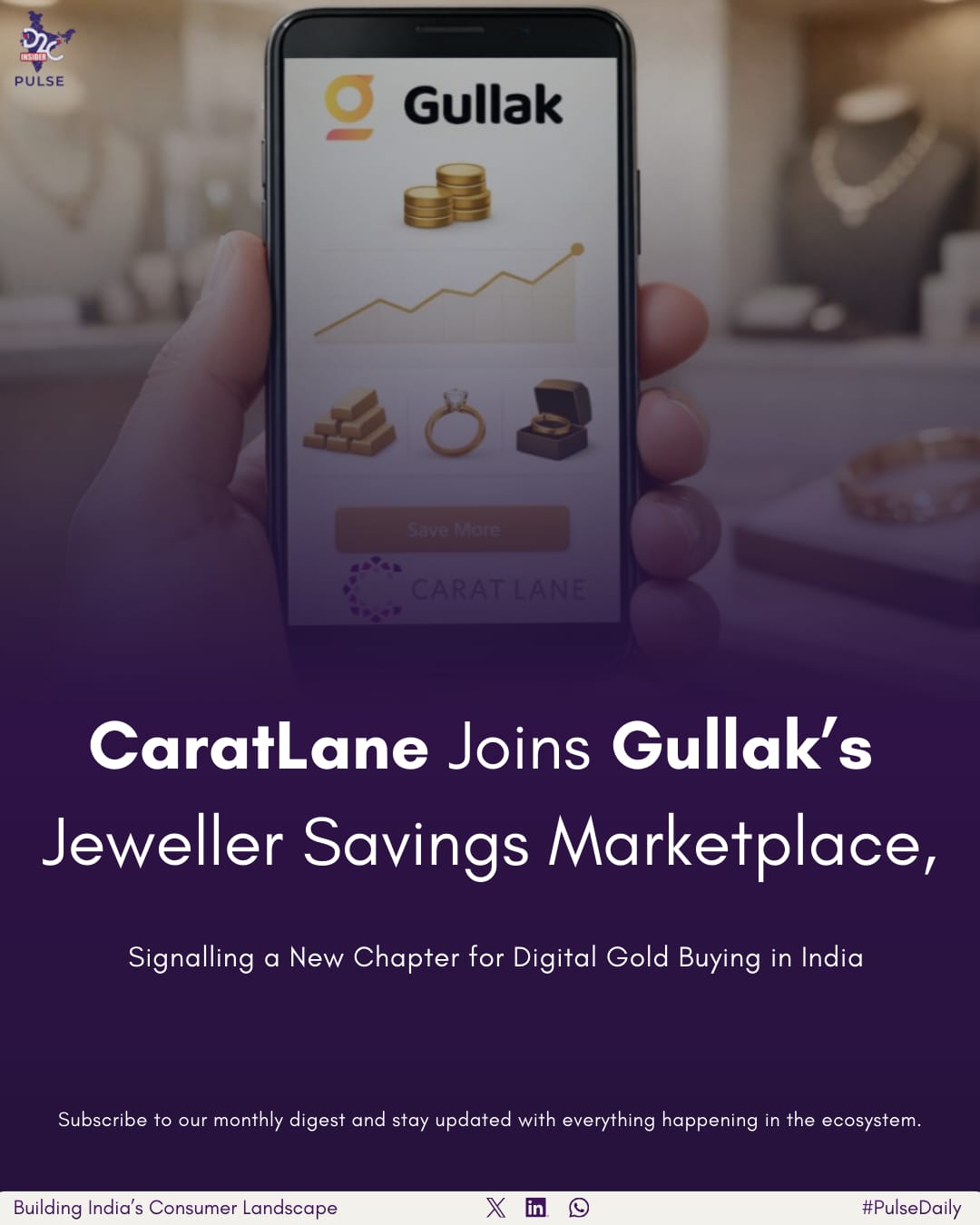
India’s gold-buying journey—deeply emotional, milestone-driven, and traditionally offline—is getting a powerful digital upgrade. CaratLane has come onboard Gullak’s newly launched jeweller savings scheme marketplace, marking a significant moment in India’s evolving D2C ecosystem for gold, jewellery, and long-term savings.
Gullak, a fast-growing digital gold savings platform, has launched what it calls India’s first jeweller savings marketplace, bringing multiple trusted jewellery brands onto a single, app-based discovery and savings experience. CaratLane is the first major jeweller to go live on the platform, with two more large jewellery brands expected to join in the coming days and 15–20 additional jewellers planned over the year. The move positions Gullak at the centre of a fragmented but massive consumer behaviour—saving for gold.
Jewellery savings schemes have always been popular in India, especially for weddings, anniversaries, festivals, and gifting. However, discovery has historically been offline and siloed, requiring consumers to visit individual stores, compare schemes manually, and commit without transparency. Gullak’s marketplace changes this by aggregating multiple jeweller schemes in one place, allowing users to compare, save, and redeem jewellery digitally—a major shift for Direct-to-consumer India and D2C business India models in the jewellery category.
For Gullak, this launch is a strategic expansion beyond digital gold accumulation into a full-stack D2C gold and jewellery ecosystem. The platform already caters to short-term gifting and long-term wealth goals, and the jeweller marketplace extends that journey from saving to redemption—bridging finance and consumption in a single flow. This aligns closely with broader D2C market trends 2025, where consumers increasingly expect seamless, end-to-end digital experiences.
Early traction indicates strong product–market fit. Within just five days of launch, Gullak reported transaction volumes exceeding those of several physical jewellery stores. Participating jewellers have seen high-quality demand, with many customers being first-time buyers who arrive with clear intent—highlighting how digital aggregation can unlock incremental demand rather than cannibalise offline sales. These signals are especially relevant in D2C industry news, where platforms that improve intent and conversion quality are gaining favour with brands.
From CaratLane’s perspective, the partnership reinforces its focus on accessibility and milestone-led buying. The brand has long positioned itself around everyday celebrations and modern jewellery consumption. By joining Gullak’s marketplace, CaratLane enables consumers to plan and save systematically for aspirational purchases such as diamond rings and tennis bracelets—making ownership more predictable and financially comfortable. This collaboration reflects how D2C brands India are increasingly partnering with fintech-like platforms to deepen engagement and lifetime value.
Gullak’s leadership sees recurring milestones—such as anniversaries and birthdays—as a core use case. By allowing users to save gradually and redeem jewellery on the same date every year, the platform taps into emotional spending while easing financial pressure. This model directly addresses evolving D2C consumer behavior India, where users value flexibility, transparency, and intent-driven purchases over impulsive buying.
Looking ahead, Gullak plans to co-create products with jewellers, offer better value through scale, and position itself as the default destination for jewellery savings in India. As more trusted brands join, the marketplace could become a key distribution and discovery channel—reshaping how jewellery is planned, saved for, and purchased.
In the broader lens of D2C news India and Indian D2C updates, the Gullak–CaratLane partnership underscores a larger shift: legacy categories like gold and jewellery are being rebuilt with digital-first, consumer-centric models. By combining trust, transparency, and technology, platforms like Gullak are not just digitising transactions—they are redefining how Indians plan for life’s most meaningful moments.