

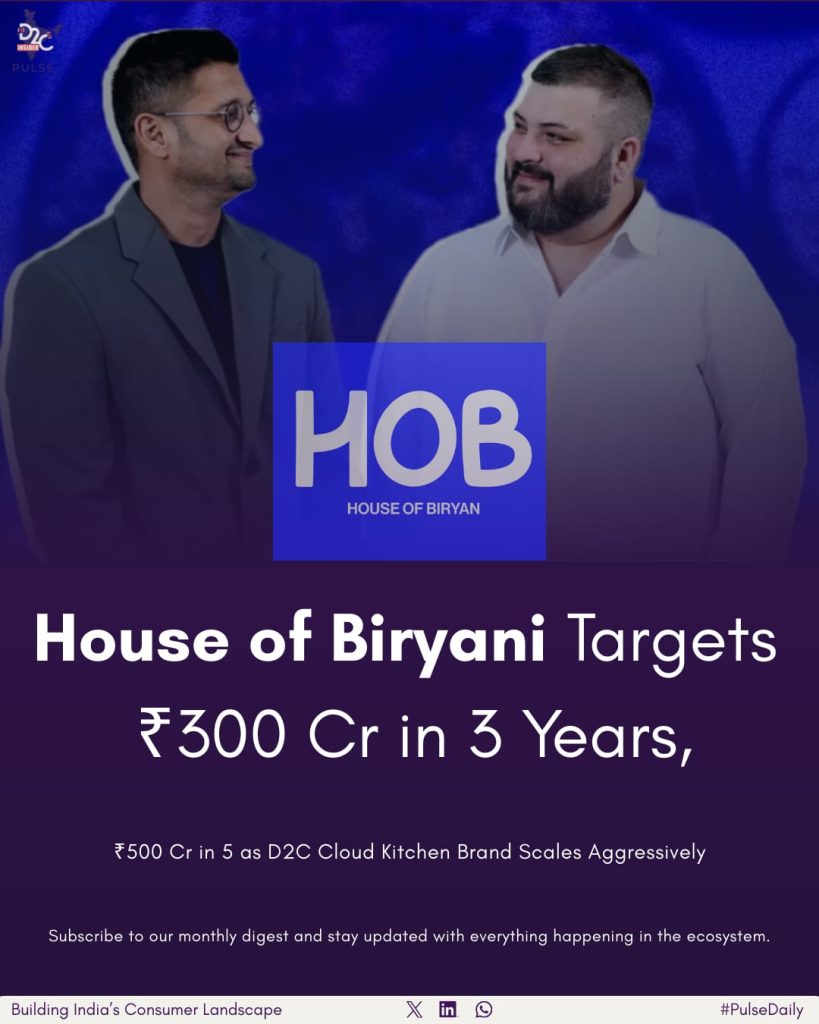
House of Biryani (HOB), a tech-enabled cloud kitchen brand, is becoming one of the rapidly growing direct-to-consumer (D2C) names in India’s food and beverage sector. The company has outlined an ambitious plan, aiming for ₹300 crore in revenue over the next three years and ₹500 crore within five years, while targeting profitability across India by the end of 2026.
Established in 2022 by Mohammed Bhol and Mikhail Shahani, with Mohit Goyal joining as co-founder in 2025, House of Biryani has swiftly expanded within the D2C ecosystem in India. Starting from a single kitchen, it now operates 26 outlets—21 in India (11 in Mumbai, 10 in Delhi) and 5 in Dubai—serving over 10 million biryanis so far. This growth illustrates effective execution of the D2C model, especially among food and beverage brands in India.
At present, HOB generates an annual recurring revenue (ARR) between ₹55 and ₹60 crore and maintains a customer repeat rate of 45%, indicating positive consumer response and a strong product-market fit. The revenue mix is dominated by biryani at 65%, followed by kebabs contributing 15–18%, with rolls, curries, and desserts making up the remainder. Offering 60 SKUs and focusing on 30–35 core items, HOB balances menu variety with operational efficiency, fostering supply chain innovations typical of the D2C approach.
Profitability remains a priority; Mumbai operations have reached corporate profitability, while Delhi is nearing break-even at the city level. The company anticipates achieving overall profitability in India by the end of 2026, consistent with emerging trends emphasizing sustainable growth and sound unit economics in the D2C market. Efforts such as reducing packaging costs by 17% have already enhanced operating margins by almost 50 basis points.
Over the past three years, the brand has raised about ₹40 crore, with founders holding more than 50% ownership, signifying strong alignment and long-term commitment—an important factor for investors in D2C ventures. Currently, HOB is seeking to raise an additional $4 million to support its next growth phase, which includes deeper expansion in India and scaling operations in the GCC region.
Within its omnichannel D2C approach, HOB is testing innovative models like self-operating biryani kiosks in Dubai, planning to deploy 50–60 such kiosks this year. These units, costing substantially less than traditional cloud kitchens, enable denser urban presence and demonstrate the company’s emphasis on operational scalability and efficiency.
The company is also preparing to introduce FMCG-ready heat-and-eat products within the next three quarters. This step will allow HOB to capture new consumer occasions and extend its reach beyond cloud kitchen operations, in line with trends in D2C product development and shifting consumer preferences.
On the branding side, Mahendra Singh Dhoni has deepened his involvement by moving from a strategic investor role to the official brand ambassador. His increased shareholding and a multi-year endorsement deal add considerable credibility and visibility, positioning HOB among celebrity-backed D2C startups.
Looking forward, while exploring international markets such as Australia, Japan, the UK, and North America, HOB remains focused on strengthening its presence in primary markets like India and the GCC. The company plans to open dine-in experience centers once it achieves an ARR of ₹150 crore, building towards a scalable brand across multiple formats.
As one of the new D2C startups reshaping India’s food ecosystem, House of Biryani exemplifies current developments driven by sound fundamentals, innovation, and brand building that are propelling the next generation of leading D2C brands and related industry updates in India.