
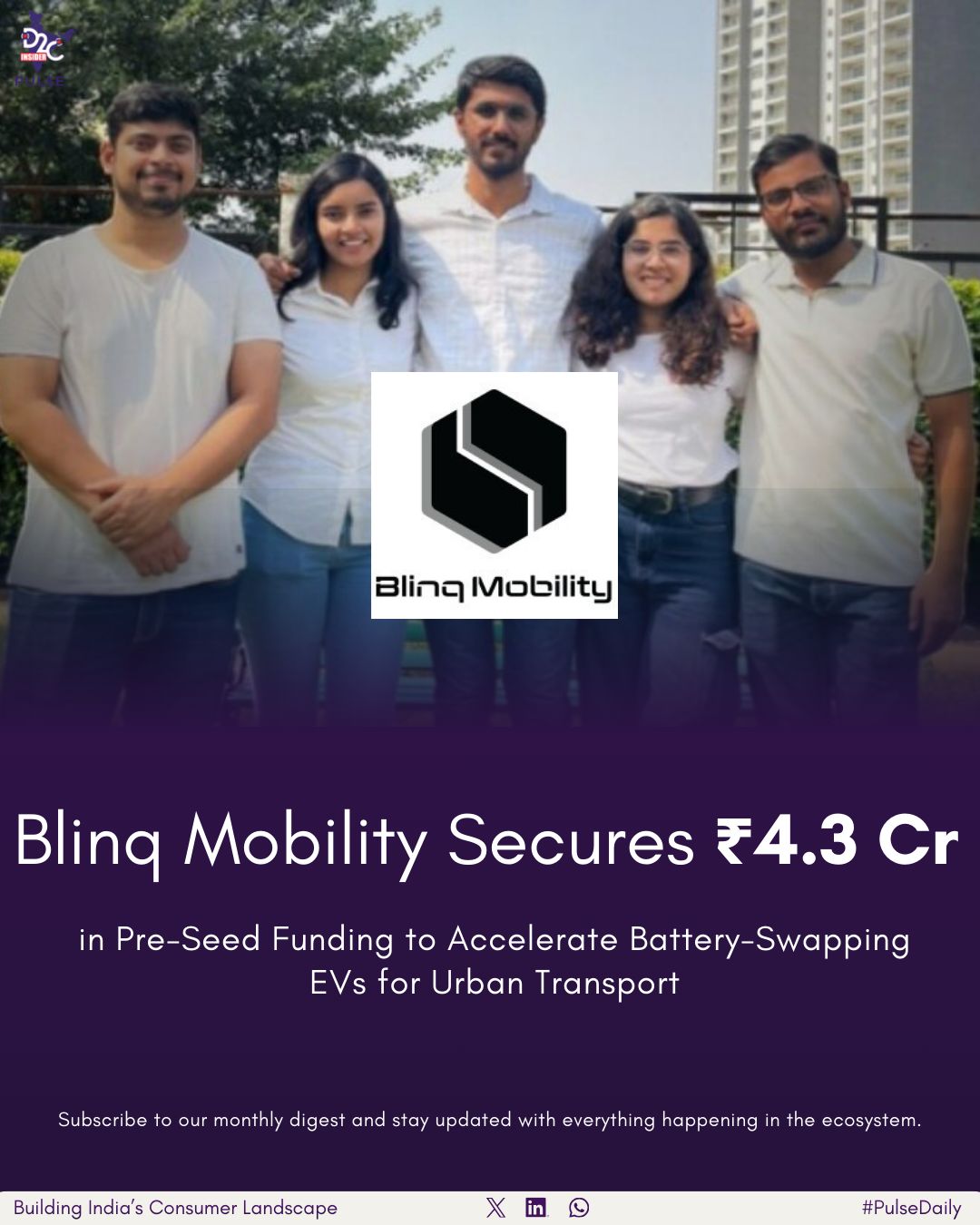
Electric vehicles are becoming more popular in India, and Blinq Mobility is a startup that’s helping to shape the future of city transportation. Founded by IIT Delhi alumni, the company has secured ₹4.3 crore in a pre-seed funding round. This money will help them develop battery-swapping electric vehicles designed for city fleets that are used a lot.
The funding was led by 8i Ventures, a venture capital firm for early-stage businesses. Other participants included IIMA Ventures, AIC Banasthali Vidyapith, and several angel investors. This funding puts Blinq Mobility on the list of new D2C startups in India, showing that investors are increasingly confident in hardware and tech-focused mobility startups that solve real operational problems.
Blinq Mobility was started by a team of engineers with lots of experience in electric vehicle systems. They are creating EVs for intensive city uses like ride-hailing, fleet logistics, and shared mobility. The founders have experience with Formula Student electric race cars and EV component , giving the startup a solid technical base. Ankit, the CTO, previously worked on Tesla’s Cybertruck and Robotaxi programs, while co-founder Abhilasha has expertise in battery technology and EV systems.
Blinq’s main focus is on battery swapping. Instead of adapting swapping to existing EV designs, they’re building a modular EV platform where the vehicle and energy system are created together. This allows batteries to be swapped quickly, reducing downtime and addressing two major issues with EV adoption in India: long charging times and high initial costs.
For vehicles that operate 16 to 20 hours a day, charging delays affect revenue and usage. Blinq’s solution combines battery swapping with a subscription-based battery plan, which lowers the initial vehicle price and ensures continuous operation. This fits with current D2C business trends in India, where ownership models are being rethought to focus on access, efficiency, and predictable costs.
The ₹4.3 crore in pre-seed funding will be used for product , vehicle engineering, battery systems, and the launch of swapping stations. Blinq is also planning pilot programs with ride-hailing and fleet partners to test real-world , unit economics, and how well the can be scaled. At the same time, the startup is creating fleet analytics and software to support its hardware and strengthen its overall value.
Blinq Mobility is being supported by the Automotive Research Association of India (ARAI) with engineering validation, certification, and regulatory compliance. Additional support from AIC Banasthali, FIIRE Goa, and the Deshpande Foundation provides access to infrastructure, mentorship, and ecosystem support, which is essential for early-stage EV startups.
Blinq plans to make money through vehicle sales or leasing, battery subscription fees, swapping station services, and fleet management software. The company aims to offer a total cost of ownership that is competitive with both traditional internal combustion vehicles and plug-in EVs, making it attractive to fleet operators who are focused on margins and uptime.
In the near future, Blinq Mobility will concentrate on pilot deployments and preparing for . Later on, the startup plans to build a global platform for modular, swappable EVs that can be used in various urban mobility applications. As interest in sustainable mobility increases and India’s EV system develops, Blinq’s integrated approach makes it a strong competitor in the next phase of EV .