
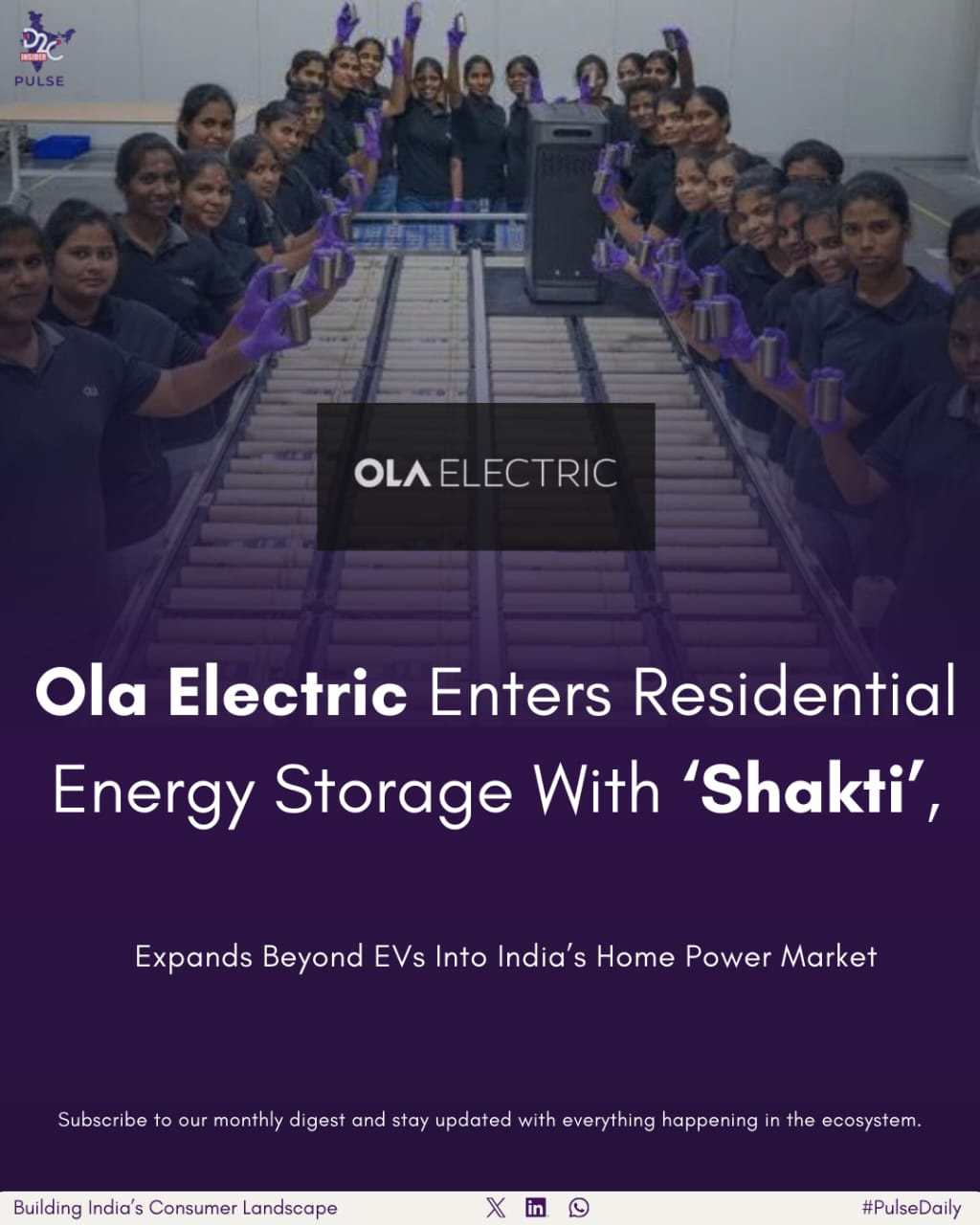
India’s D2C ecosystem is witnessing a steady expansion of new-age brands moving beyond their core categories to unlock adjacent growth opportunities. In a significant development within D2C news India and D2C industry news, Ola Electric has officially launched ‘Shakti’, its first Battery Energy Storage System (BESS) for homes, farms, and small businesses—marking the company’s entry into India’s residential energy storage market and a strategic expansion beyond the automotive domain.
The rollout of Ola Shakti from the company’s Gigafactory in Krishnagiri, Tamil Nadu, signals a decisive step in Ola Electric’s long-term ambition to become a full-stack energy company. Built on the company’s indigenous 4680 Bharat Cell, Shakti is positioned as a reliable, affordable, and intelligent energy storage solution designed specifically for Indian power conditions.
Commenting on the launch, an Ola Electric spokesperson said the introduction of Shakti represents a defining moment in the company’s journey to build the future of energy in India. The company highlighted that Shakti aims to make dependable energy storage accessible across Indian households, farms, and small commercial establishments—areas that continue to face frequent power fluctuations and outages.
For India’s evolving Direct-to-Consumer India hardware and energy market, Ola Shakti represents a notable D2C product launch. Unlike conventional lead-acid inverters or diesel generators, Shakti operates across a wide input voltage range of 200V–240V, helping protect appliances from voltage fluctuations. The system is also spill-proof and uses IP67-rated batteries, tested for dust, water ingress, and harsh monsoon conditions—making it well-suited for Indian environments.
Ola Shakti is available in four configurations: 1kW/1.5kWh, 1kW/3kWh, 3kW/5.2kWh, and 6kW/9.1kWh. Depending on the variant, the system can power essential household and commercial equipment such as air conditioners, refrigerators, induction cookers, farm pumps, and communication devices. Charging times can be as fast as two hours, with a backup capacity of up to 1.5 hours at full load, addressing a key pain point for Indian consumers seeking dependable power continuity.
From a D2C business India perspective, Ola Electric’s entry into residential BESS underscores a broader trend: large consumer tech brands leveraging their manufacturing scale, R&D capabilities, and direct distribution models to enter adjacent categories. Much like Ola’s electric scooters, Shakti is being offered through a direct-to-consumer model, with reservations now live on the company’s website at a highly accessible ₹99.
This launch also aligns with India’s rapidly evolving energy landscape. As rooftop solar adoption increases and consumers look for ways to reduce dependence on the grid, residential energy storage is emerging as a high-growth category. By combining in-house cell manufacturing, software-led intelligence, and D2C distribution, Ola Electric is positioning itself at the intersection of clean energy, consumer electronics, and infrastructure—an increasingly attractive space for investors tracking D2C market trends 2025.
For Ola Electric, Shakti complements its broader ecosystem play. The company has already invested heavily in cell manufacturing, EV platforms, and charging infrastructure. Extending these capabilities into home energy storage allows Ola to deepen consumer relationships beyond mobility, strengthen lifetime value, and diversify revenue streams—key themes in D2C brand building stories.
From an ecosystem standpoint, the move reinforces how India’s D2C brands are maturing—moving from single-product companies to multi-category platforms addressing everyday consumer needs. While Ola Electric is best known for EVs, Shakti signals its ambition to become a household energy brand, not just an automotive one.
As Indian D2C updates continue to highlight convergence across mobility, energy, and consumer tech, Ola Electric’s Shakti launch stands out as a bold bet on the future of decentralised, consumer-owned energy—delivered through a scalable, direct-to-consumer model.