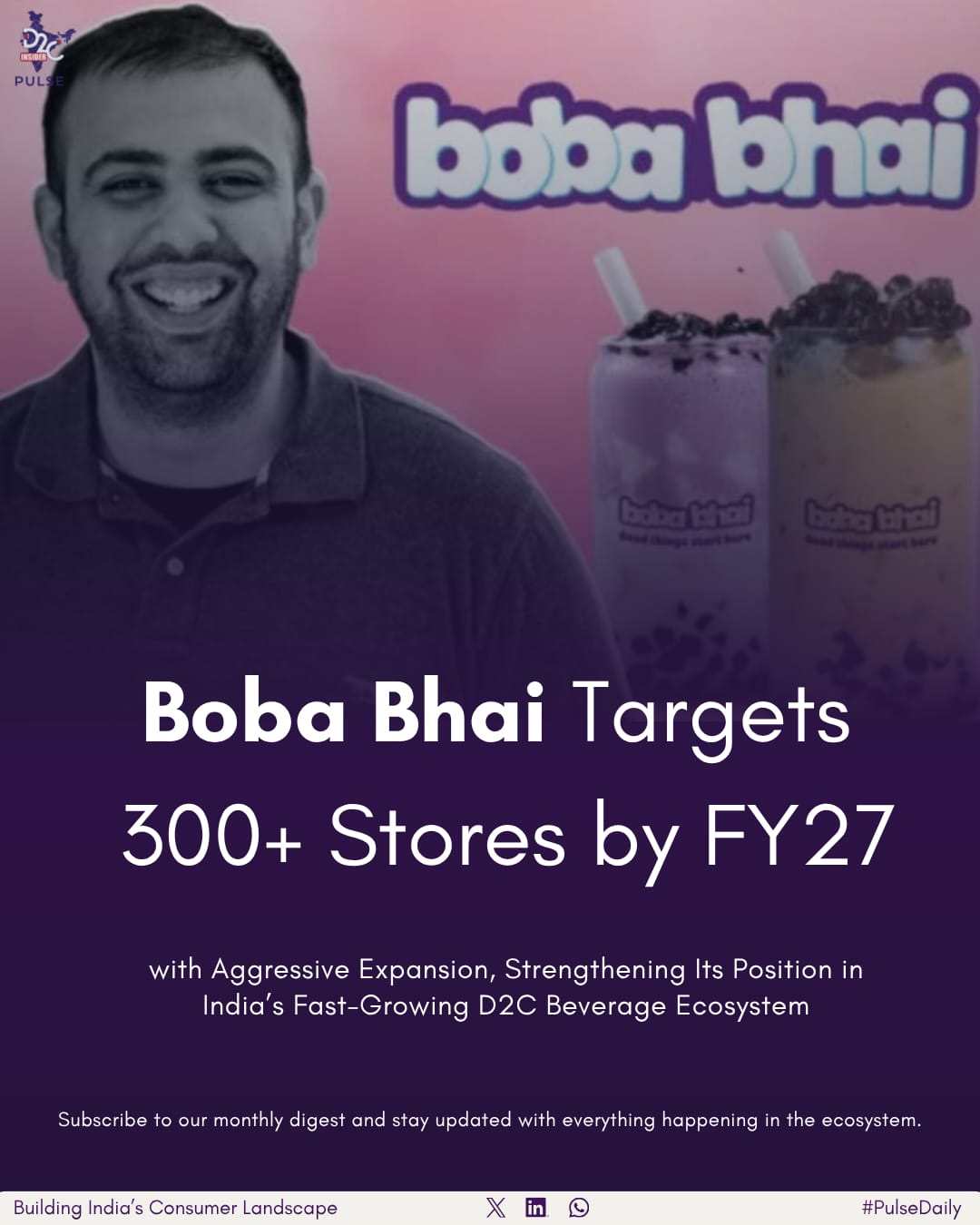
bubble tea brand Boba Bhai is accelerating its growth journey with ambitious expansion plans, reinforcing its position among the fastest-growing D2C brands India in the D2C food and beverage brands category. The company is targeting the addition of 150–200 outlets this financial year, aiming to scale from nearly 100 stores to over 300 outlets, marking a significant milestone in the evolving D2C ecosystem India.
Founded with a strong focus on youth-driven consumption, Boba Bhai currently operates in eight cities, including Bengaluru, Mumbai, and Delhi, and plans to expand to 10 cities in the near term. This phase of consolidation reflects a strategic D2C business model India approach—deepening presence in existing markets before expanding into tier-II and tier-III cities. As part of Indian D2C updates and latest D2C startups scaling strategies, this move aligns with broader D2C market trends 2025, where brands are prioritizing depth before breadth.
The company’s expansion is backed by recent D2C funding rounds, with capital being strategically deployed toward store growth and infrastructure. This places Boba Bhai firmly within the conversation of VC-backed D2C brands and D2C funding news, as investors continue to back scalable, consumer-focused businesses. While not directly linked to D2C IPO news yet, such aggressive scaling and strong unit economics often signal future opportunities in the direct-to-consumer startup IPO tracker.
A standout aspect of Boba Bhai’s growth story is its strong focus on profitability—an increasingly critical factor in D2C investor insights and private equity in D2C discussions. The brand reports approximately 20% profitability at the store level, with a relatively short payback period of 12–14 months per outlet. At a company level, it is approaching breakeven, highlighting disciplined execution and sustainable D2C revenue growth—key traits of the best performing D2C brands FY25.
Unlike many competitors, Boba Bhai operates on a company-owned, company-operated model, avoiding franchising to maintain tighter control over quality, operations, and margins. This reflects a thoughtful omnichannel D2C strategy and strong D2C supply chain innovation, ensuring consistency as the brand scales rapidly.
From a consumer lens, the brand is tapping directly into evolving D2C consumer behavior India, particularly among Gen Z. With younger consumers increasingly moving toward social, experience-driven consumption and functional beverages, Boba Bhai is positioning itself at the intersection of product and experience. Its outlets are evolving into social spaces rather than just transactional points, driving higher engagement and increasing average order values, currently at ₹350–400 and rising.
The company is also witnessing strong traction beyond metro markets, with tier-II cities emerging as high-potential growth hubs. This aligns with what’s happening in India’s D2C space today—where demand is no longer limited to urban centers, and D2C brands scaling in 2025 are increasingly targeting the top 50–70 cities across India. Boba Bhai’s vision to “own the top 70 cities” reflects a bold yet calculated D2C go-to-market strategy.
Looking ahead, the brand is targeting 1,000 outlets over the next five years, with potential international expansion on the horizon. Despite input cost pressures, the company is choosing to absorb costs to retain customer loyalty—an approach that strengthens long-term brand equity and reinforces its place in D2C brand building stories.
As part of the daily digest of D2C news in India, Boba Bhai stands out as a compelling example of how strong fundamentals, consumer insight, and disciplined expansion can drive rapid scale. With a clear roadmap, strong investor backing, and a deep understanding of its audience, the brand is well-positioned to become a leading player in India’s premium D2C beverage and QSR ecosystem.