
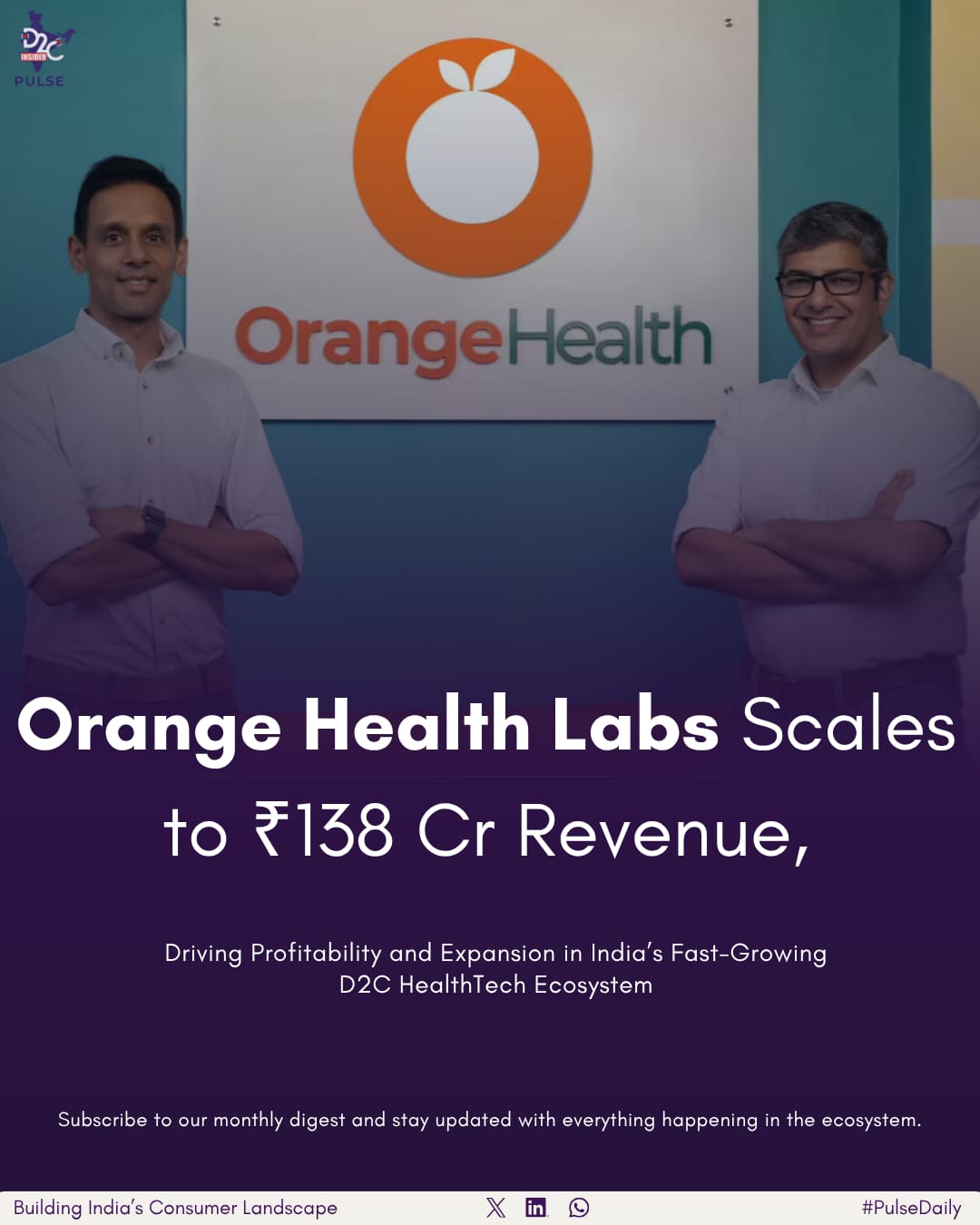
Orange Health Labs is emerging as one of the fastest-growing D2C brands India in the healthcare space, reporting a strong ₹138 crore revenue in FY26, up from ₹85 crore last year—a remarkable 65% year-on-year growth. As part of the evolving Direct-to-consumer India landscape, the company exited the year at an annualised run rate of ₹180 crore and expects to grow another 60–70% next year, reinforcing its position in the rapidly expanding D2C ecosystem India.
This growth reflects a larger transformation in D2C industry news and Indian D2C updates, where at-home diagnostics and preventive healthcare are becoming central to D2C consumer behavior India. Orange Health Labs is capitalizing on this shift, aligning with D2C market trends 2025 that emphasize convenience, speed, and accessibility. At-home testing, which was under 10% of the diagnostics industry five years ago, now accounts for nearly 20–25% and continues to grow faster than the overall market—highlighting a significant opportunity for D2C wellness startups.
Preventive healthcare is another strong growth driver. What was once an 8–12% segment has now expanded to 25–30% of the market, with Orange Health Labs deriving nearly 35–40% of its business from preventive diagnostics. This positions the company strongly among premium D2C brands India that are not only scaling but also reshaping consumer habits through proactive health monitoring.
A key differentiator in Orange Health Labs’ D2C business model India is its logistics-first approach, showcasing strong D2C supply chain innovation. The company has reduced sample collection time from 60 minutes to just 30 minutes and is working toward near-instant bookings. Its hub-based, FedEx-like reverse logistics system allows samples to be processed faster by leveraging automated hubs rather than relying solely on centralized labs. This operational efficiency is a major contributor to its strong D2C revenue growth and improving margins.
From a financial perspective, the company is demonstrating clear progress toward profitability—an important signal in D2C funding news and D2C investor insights. Bengaluru, which contributes nearly half of total revenue, is already operating at a ₹85–90 crore run rate with 20% EBITDA profitability. Several other cities are expected to achieve breakeven in the coming year, reflecting disciplined execution and strong fundamentals, key traits of VC-backed D2C brands and top funded D2C brands.
While this growth is not directly tied to new D2C funding rounds or D2C IPO news, it strengthens the company’s position in the broader narrative of private equity in D2C and future capital opportunities. Its consistent performance, scalability, and profitability trajectory make it a strong contender in the direct-to-consumer startup IPO tracker over time.
To further expand its reach, Orange Health Labs is adopting an omnichannel D2C strategy by increasing its physical footprint. The company has scaled from 15 to over 75 company-owned collection centers in the past year and plans to reach 200 centers by the end of the fiscal. This hybrid approach of digital-first convenience combined with offline presence reflects the evolving D2C retail vs ecommerce dynamics.
Looking ahead, the company plans to expand into 10–12 cities over the next two to three years and diversify into adjacent categories such as radiology and scans. This aligns with broader D2C expansion plans and D2C product launches strategies seen across latest D2C startups.
As part of the daily digest of D2C news in India, Orange Health Labs stands out as a compelling example of how innovation, execution, and consumer insight are driving the next wave of D2C brand building stories. It reflects what’s happening in India’s D2C space today—where healthcare, technology, and direct-to-consumer models are converging to create scalable, impactful businesses.