
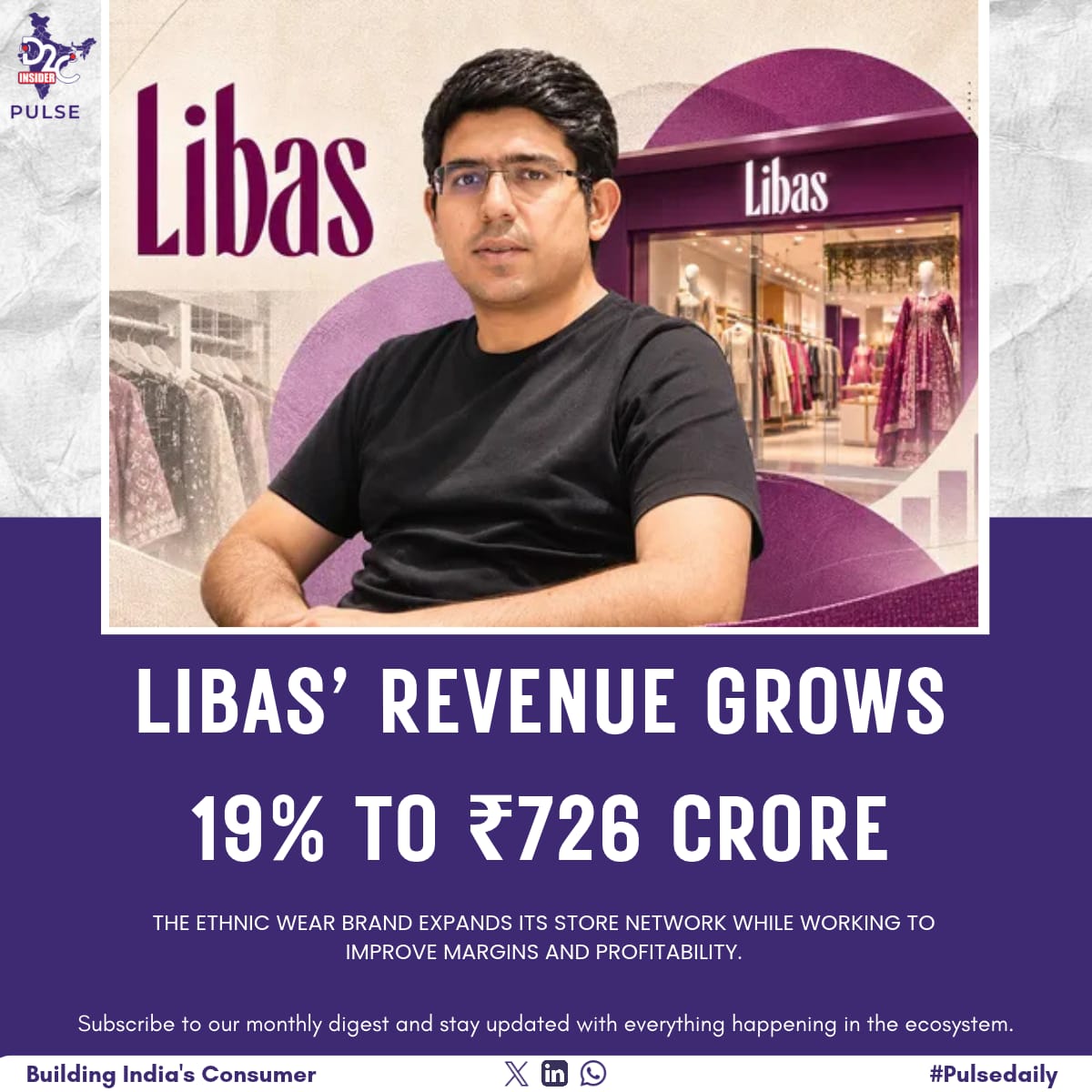
Women’s ethnic and fusion wear brand Libas reported operating revenue of ₹726 crore in FY26, a 19% increase from the previous year, as it continued to expand its retail footprint and strengthen its omnichannel presence. The Gurugram-based company narrowed its net loss marginally to ₹15.2 crore, although rising material, employee and marketing costs continued to weigh on profitability.
Founded in 1985, Libas sells kurtas, suits, sarees, lehengas, dresses and bottom wear through its own digital platform, marketplaces and exclusive brand outlets. Apparel remained its sole source of operating revenue in FY26, making its performance closely tied to product sourcing, inventory management and the economics of fashion retail.
The company’s offline expansion has gathered pace. It opened 28 stores during FY26, compared with 10 in the preceding fiscal, and had more than 55 exclusive brand outlets at the time of the latest report. It is targeting more than 50 additional outlets in FY27. Its online distribution includes platforms such as Myntra, Amazon and Flipkart, alongside its own website.
The financial results show growth, but also the cost of scaling. Material consumption increased 34.6% to ₹426.7 crore from ₹316.9 crore, accounting for approximately 57% of total expenses. Employee benefit expenses rose 53% to ₹67.7 crore, while advertising and promotional expenditure increased 17.9% to ₹66 crore.
Total expenses grew 19.6% to ₹742.8 crore. Libas reported a net loss of ₹15.2 crore, narrowing 7.9% from ₹16.5 crore in FY25. It remained EBITDA-positive, with an operating surplus of approximately ₹4 crore, although its EBITDA margin was only 0.55%. The company spent approximately ₹1.02 for every rupee of operating revenue.
The business had raised ₹150 crore in May 2024 from IAF Series 5, a fund managed by ICICI Venture, marking its maiden external funding round. The capital and subsequent store expansion have supported its transition into a larger omnichannel fashion business.
Libas operates in a competitive market alongside established players such as Biba and Manyavar, as well as newer digital-first labels. Its affordable ethnic and fusion wear positioning gives it access to a broad consumer base, but sustained growth will depend on managing inventory, sourcing costs and store-level productivity as the retail network expands.
The FY26 performance reflects a brand that is continuing to grow its revenue base and physical distribution, while still working through the challenge of converting scale into stronger profitability. The next phase will test whether its store additions and online reach can deliver better operating leverage without further compressing margins.
Source note: Financial figures are based on FY26 company statements filed with the Registrar of Companies and reported by Entrackr. Store expansion and FY27 targets are based on recent retail industry reporting.