
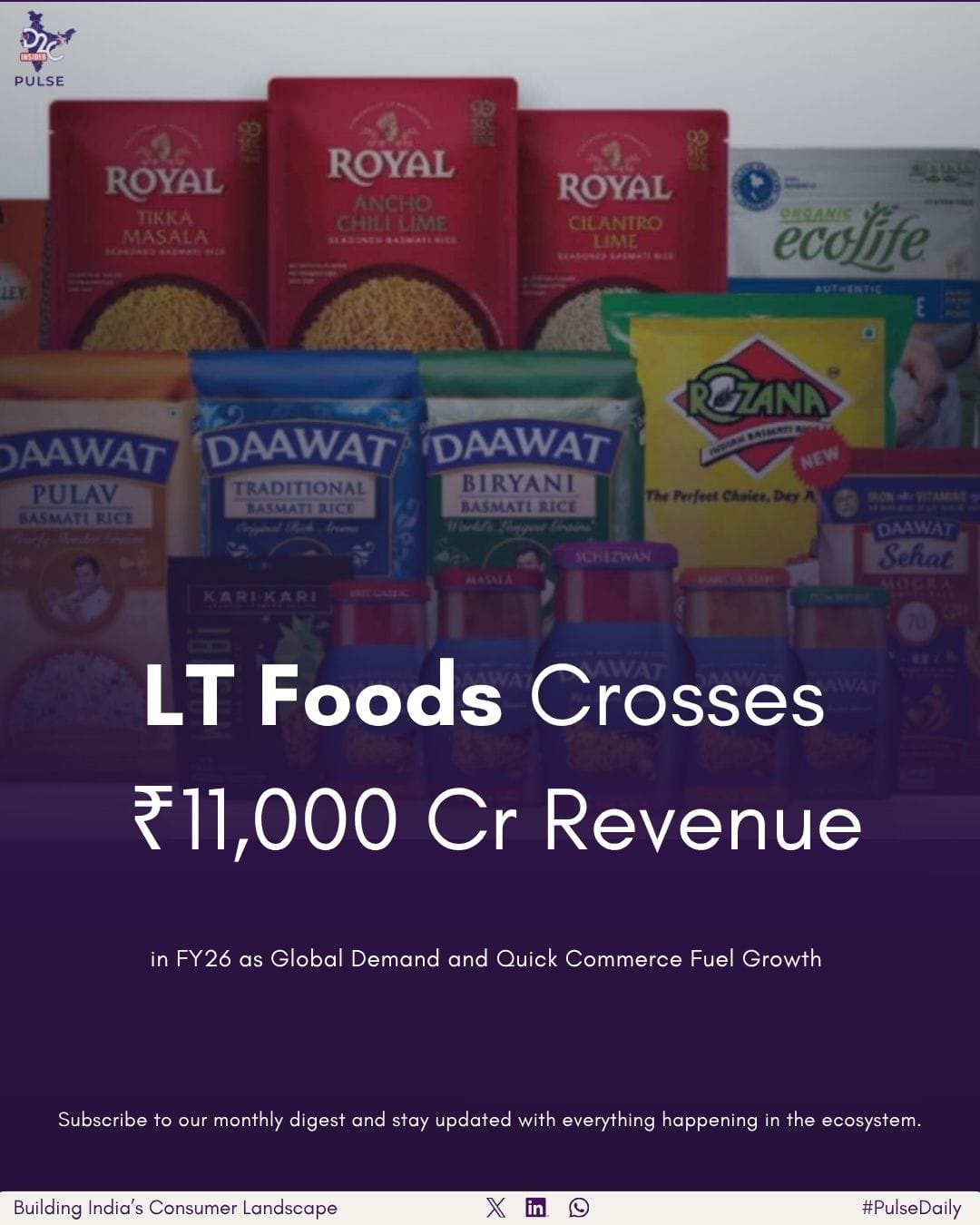
India’s packaged food and branded staples market continues to witness strong momentum, and LT Foods has emerged as one of the biggest growth stories in the sector. In one of the latest Indian D2C updates and D2C industry news developments, LT Foods reported a 26 percent year-on-year rise in consolidated revenue to ₹11,023 crore in FY26, driven by strong global demand, rapid premiumisation, quick commerce expansion, and growing traction across branded packaged food categories.
The strong performance highlights how established food brands are increasingly adapting to India’s rapidly evolving direct-to-consumer India landscape, where premium food consumption, omnichannel distribution, and quick commerce D2C channels are reshaping consumer buying behaviour. Across D2C news India, D2C daily news, and D2C business India, food and beverage brands continue to remain among the fastest-growing categories within the broader D2C ecosystem India.
LT Foods said EBITDA rose 16 percent year-on-year to ₹1,236 crore during FY26, while profit after tax stood at ₹625 crore compared to ₹612 crore in FY25. For the March quarter alone, the company posted revenue of ₹2,938 crore, marking a 30 percent year-on-year increase, while EBITDA came in at ₹300 crore.
The company’s flagship basmati and specialty rice segment remained the primary growth driver, expanding 29 percent during FY26 to ₹9,742 crore. LT Foods also said its organic foods and ingredients business crossed ₹1,016 crore in revenue, reflecting rising consumer demand for healthier and premium food products globally. Meanwhile, the ready-to-eat and ready-to-cook business reached ₹187 crore in FY26, growing 2.5 times over the last five years.
The latest D2C startup news and D2C market trends 2025 indicate that consumers are increasingly shifting toward premium packaged foods, convenience-led consumption, and branded food experiences. This trend is accelerating growth for both legacy FMCG players and modern D2C food and beverage brands across India and international markets.
North America remained LT Foods’ largest market, contributing 48 percent of the company’s revenue mix during FY26. Revenue from the region grew 53 percent during the year, or 9 percent on a normalized basis excluding the impact of US tariffs. Europe also posted strong 34 percent revenue growth, while the company continued expanding its branded presence in Saudi Arabia, generating ₹23 crore in revenue from the market over the last year.
In India, LT Foods reported 10 percent value growth and 12 percent volume growth during FY26. One of the strongest highlights for the company came from e-commerce and quick commerce channels, which grew over 45 percent during the year. The premium segment also expanded at twice the pace of the overall consumer portfolio, underlining the broader premiumisation wave currently shaping D2C consumer behavior India.
The company added that reported margins for FY26 and the March quarter were impacted by zero-margin US tariff pass-through adjustments and freight reclassification changes, although absolute EBITDA remained unchanged. On a normalized basis, EBITDA margin for FY26 stood at 11.8 percent compared to the reported 11.2 percent.
LT Foods also flagged near-term pressure arising from tariff-related developments in the US market and higher input costs. However, the company said it continues investing aggressively in brand building, distribution expansion, and global scaling initiatives, including strengthening operations in the UK and remodeling its organic business segment for future growth.
The strong FY26 performance reinforces how India’s packaged foods and premium staples category is rapidly evolving within the larger D2C ecosystem India. From omnichannel D2C strategy and quick commerce expansion to premium branded food consumption and international growth, LT Foods is positioning itself strongly among the top-performing consumer brands scaling in 2025.
As D2C brands India continue expanding globally, LT Foods’ latest growth numbers reflect how premium food positioning, operational scale, and distribution-led execution are becoming critical drivers of long-term success across India’s fast-growing consumer and D2C business landscape.