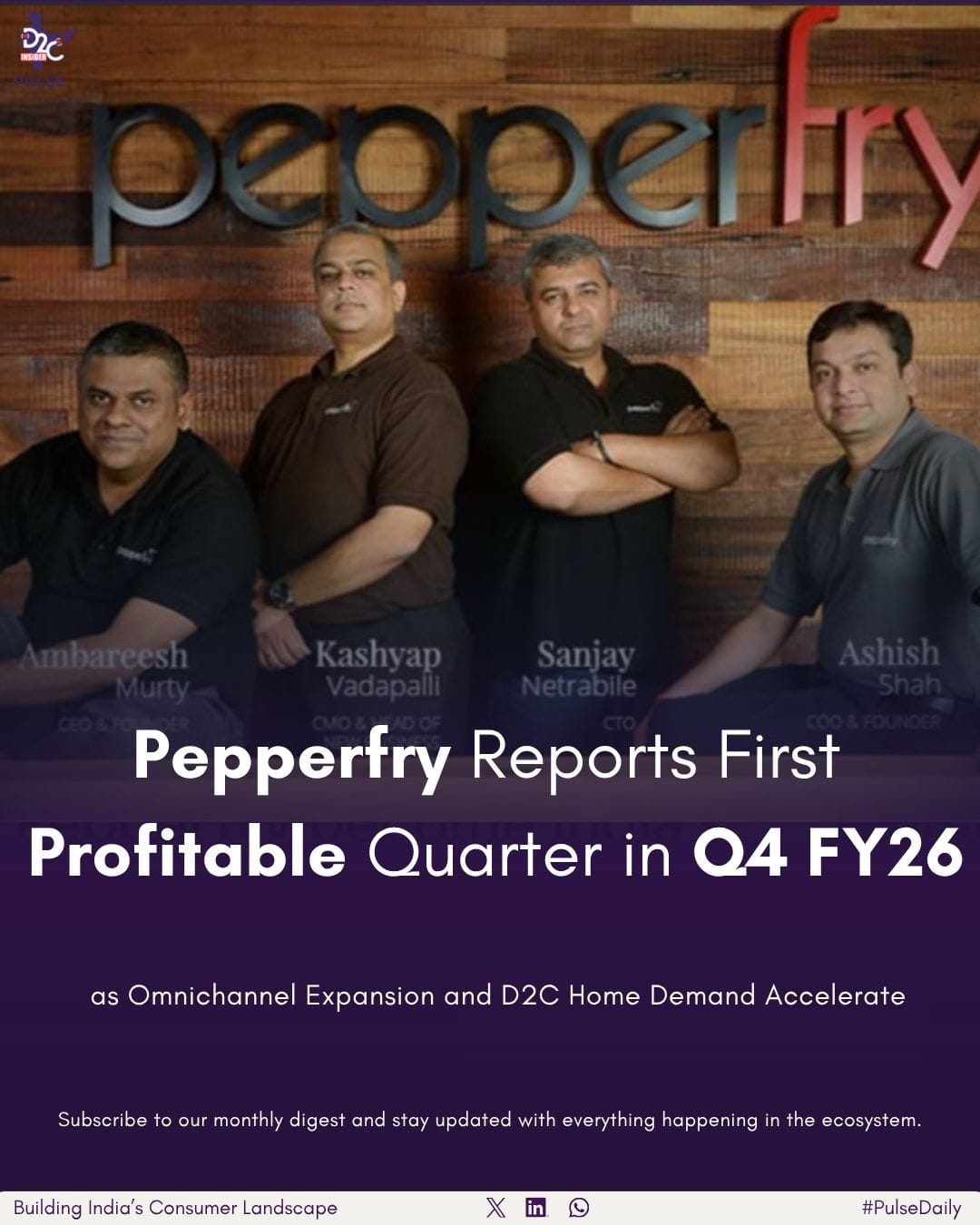
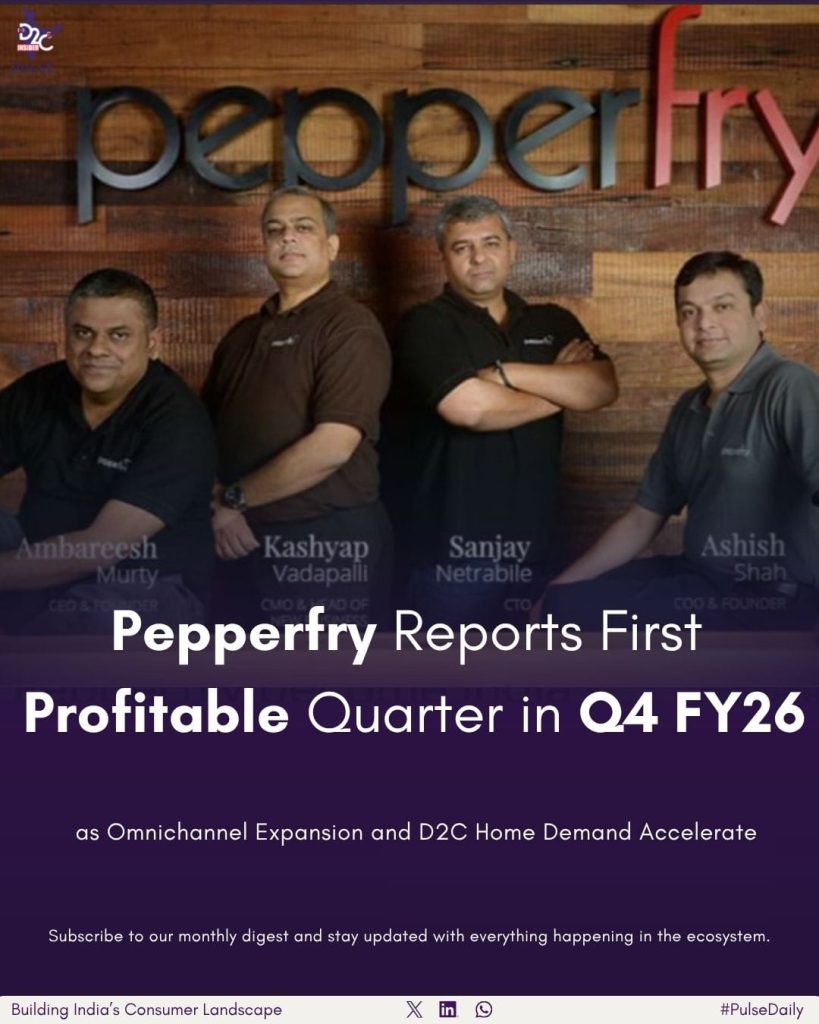
In one of the most significant D2C industry news developments within India’s home and furniture market, Pepperfry has reported its first profitable quarter in Q4 FY26, marking a major milestone in the company’s long-term growth journey. The achievement reflects how India’s leading Direct-to-consumer India brands are increasingly moving toward sustainable and disciplined growth while continuing to scale aggressively across omnichannel retail, supply chain infrastructure, and technology-led commerce.
Pepperfry Limited, a TCC Group company, said the profitability milestone comes after several years of structural transformation, operational optimisation, and strategic business realignment aimed at improving customer experience, increasing operational efficiency, and building a more resilient omnichannel D2C strategy.
The development is especially important within the broader D2C ecosystem India and Indian D2C updates landscape, where profitability and sustainable scaling are becoming key priorities for both startups and investors. As India’s furniture and home category rapidly formalises, brands with strong omnichannel capabilities, logistics infrastructure, and supply chain innovation are emerging as category leaders.
According to the company, multiple growth drivers contributed to the profitable quarter, including deeper omnichannel integration, direct retail selling capabilities following Pepperfry’s integration with TCC Group, stronger conversion rates, improved average order values, and the expansion of its studio-led retail network to over 100 locations across India.
Pepperfry also highlighted its growing position as a platform for design-led and D2C home brands India, reflecting larger D2C market trends 2025 where consumers increasingly seek curated, premium, and digitally discoverable home solutions. The company’s marketplace ecosystem, logistics capabilities, and furniture supply chain network also played an important role in driving efficiency and scale.
Ashish Shah, Co-Founder of Pepperfry, described the milestone as a validation of long-term conviction and disciplined execution. According to Shah, the company spent the last several years simplifying operations, sharpening focus areas, and rebuilding the business around sustainable growth fundamentals. He added that Pepperfry now plans to accelerate omnichannel expansion, strengthen its B2B and furnishing businesses, launch new categories, and continue investing in technology, logistics, and supply chain capabilities.
Within D2C business India, Pepperfry’s profitability milestone reflects a larger shift taking place across India’s consumer internet ecosystem. Rather than chasing scale at any cost, many VC-backed D2C brands are increasingly focusing on operational excellence, efficient customer acquisition, better unit economics, and long-term profitability.
TCC Concept Limited also reported strong FY26 financial performance, highlighting the broader strength of the integrated business ecosystem. According to the company, consolidated revenue from operations increased 116% year-on-year to ₹1,793.9 million. Consolidated EBITDA stood at ₹1,242.7 million with EBITDA margins of 69.28%, while PAT rose to ₹648.2 million with PAT margins of 36.14%.
The company’s Q4 FY26 momentum remained equally strong, with consolidated revenue from operations reaching ₹838.7 million, EBITDA touching ₹499.6 million, and PAT standing at ₹309.8 million. These numbers underline the growing strength of integrated omnichannel retail ecosystems within India’s rapidly expanding D2C ecosystem.
Across D2C consumer behavior India, home and lifestyle consumption continues witnessing strong momentum as younger consumers increasingly invest in furniture, home décor, modular living, and design-led interiors. This has created significant opportunities for organised D2C brands India operating across furniture, furnishing, and lifestyle categories.
Pepperfry’s growing omnichannel network, combined with its marketplace depth, retail studios, logistics ecosystem, and technology investments, positions the company strongly within India’s evolving home and lifestyle market. The company plans to continue expanding its omnichannel footprint while strengthening its furnishing and B2B businesses during FY27.
As India’s D2C ecosystem continues maturing rapidly, Pepperfry’s first profitable quarter stands out as a strong example of how operational discipline, omnichannel execution, technology-led retail, and long-term brand building can create sustainable growth within one of India’s most competitive consumer categories.