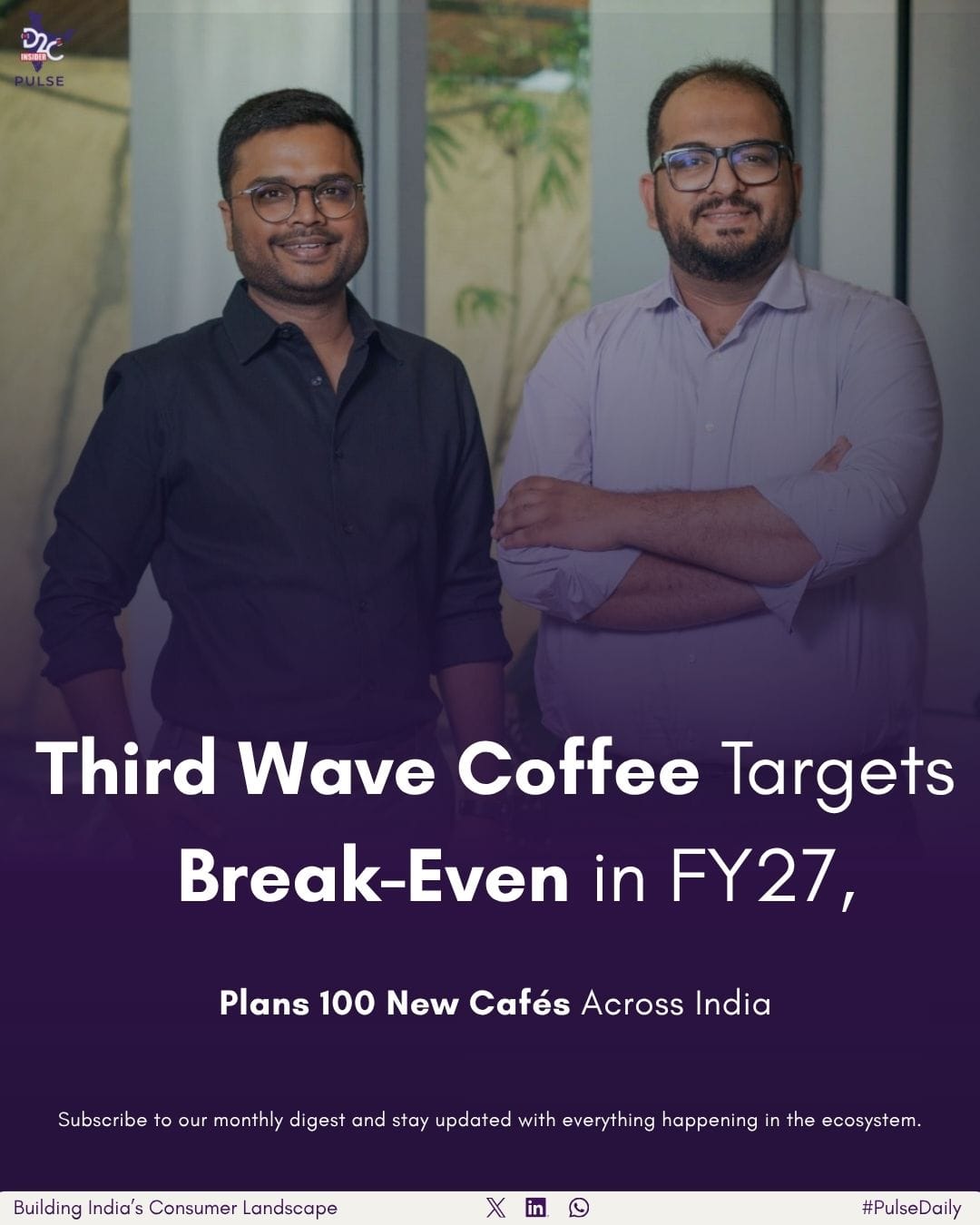
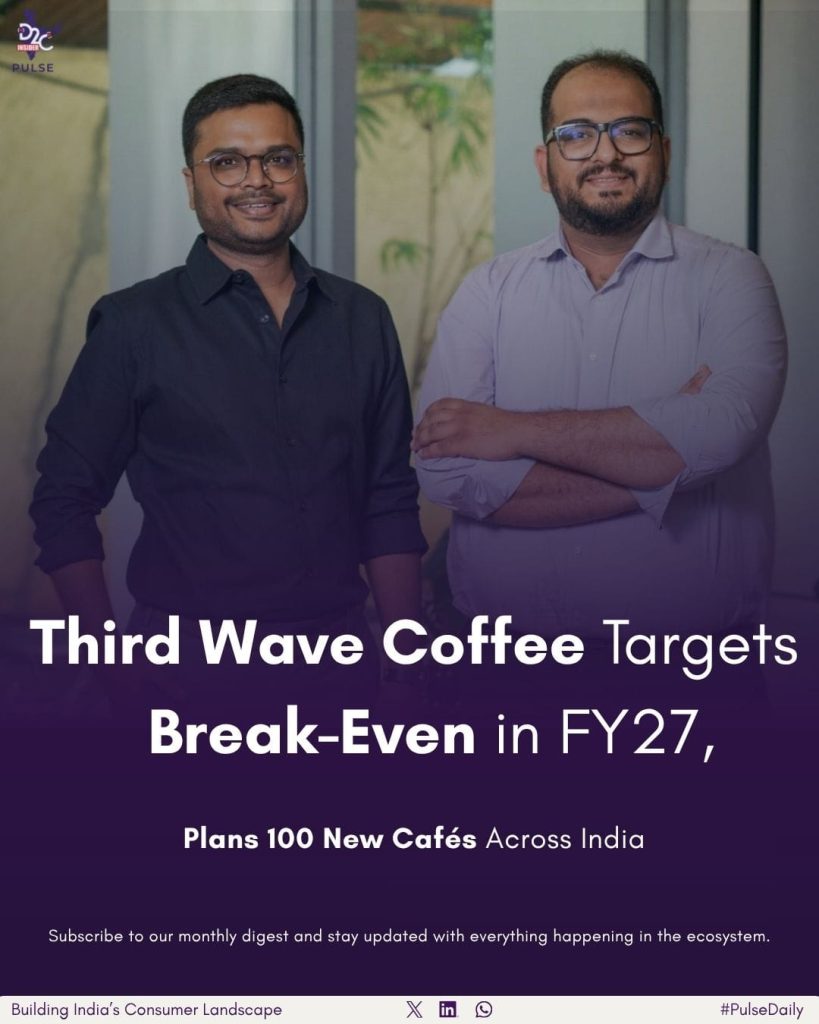
India’s premium café and quick service restaurant (QSR) market continues to witness strong momentum, and Third Wave Coffee is emerging as one of the fastest-growing consumer brands in the space. In a major development for D2C news India and the broader D2C ecosystem India, the Bengaluru-based coffee-first QSR chain has announced plans to open 100 new cafés during FY27 while targeting company-level break-even within the current financial year.
The expansion highlights the growing strength of omnichannel consumer brands and reinforces the rising influence of premium D2C food and beverage brands in India. As consumer preferences continue shifting toward experience-led retail, specialty beverages, and premium food offerings, Third Wave Coffee is positioning itself for its next phase of growth across both existing and new markets.
Currently operating more than 220 cafés across India, Third Wave Coffee follows a company-owned-company-operated (COCO) model and has no immediate plans to adopt a franchise-led approach. The strategy reflects the brand’s focus on maintaining operational consistency, customer experience, and long-term profitability while scaling rapidly across the country.
According to the company, approximately 90% of its stores are already EBITDA positive, demonstrating strong unit economics and validating its expansion model. With store-level profitability firmly established, the company is now focused on achieving company-level break-even in FY27, a significant milestone for one of India’s fastest-growing premium coffee chains.
The latest D2C business India update comes as Third Wave Coffee expands aggressively into eastern India. The company recently launched three new cafés in Kolkata, including two locations in Ballygunge and one in Salt Lake. It now plans to add another five to six stores in the city during the current financial year. Beyond Kolkata, the brand is actively evaluating new opportunities across Guwahati, Ranchi, Patna, and Bhubaneswar, further strengthening its footprint in emerging consumer markets.
As part of its broader D2C expansion plans, around 60-70% of the 100 new stores planned for FY27 will be launched in cities where the company already has a strong presence. The remaining 30-40% will be opened in new markets, enabling the brand to balance market penetration with geographic expansion. The company expects to open two to three stores in each new city while building Kolkata into a major regional hub with a projected network of 10-12 cafés.
The company’s current footprint includes 64 stores in Bengaluru, 48 in Delhi NCR, 40 in Mumbai, 18 in Pune, 13 in Hyderabad, and eight in Chennai. During the previous financial year, Third Wave Coffee expanded into Ahmedabad and Agra while also entering strategic transit destinations such as the Delhi-Mumbai Expressway. Simultaneously, it deepened its presence across key metropolitan markets including Delhi NCR, Hyderabad, Chennai, Mumbai, and Mysuru.
The brand’s growth strategy is closely aligned with evolving D2C consumer behavior India trends, where customers increasingly seek premium experiences, high-quality products, and community-driven retail spaces. By sourcing 100% Indian coffee and operating one of the country’s largest coffee roasteries, Third Wave Coffee has built a strong supply chain foundation that supports both quality and scalability.
As D2C brands India continue expanding through omnichannel D2C strategy models, Third Wave Coffee stands out as a compelling example of sustainable growth, disciplined expansion, and strong operational execution. With 100 new cafés planned, expanding regional presence, and company-level profitability in sight, the brand is strengthening its position as one of the fastest-growing consumer businesses in India’s premium café ecosystem.
For investors, operators, and industry observers tracking D2C industry news, D2C startup news, D2C revenue growth, and India’s D2C market news and insights, Third Wave Coffee’s latest growth roadmap signals continued confidence in India’s rapidly evolving premium food and beverage sector.