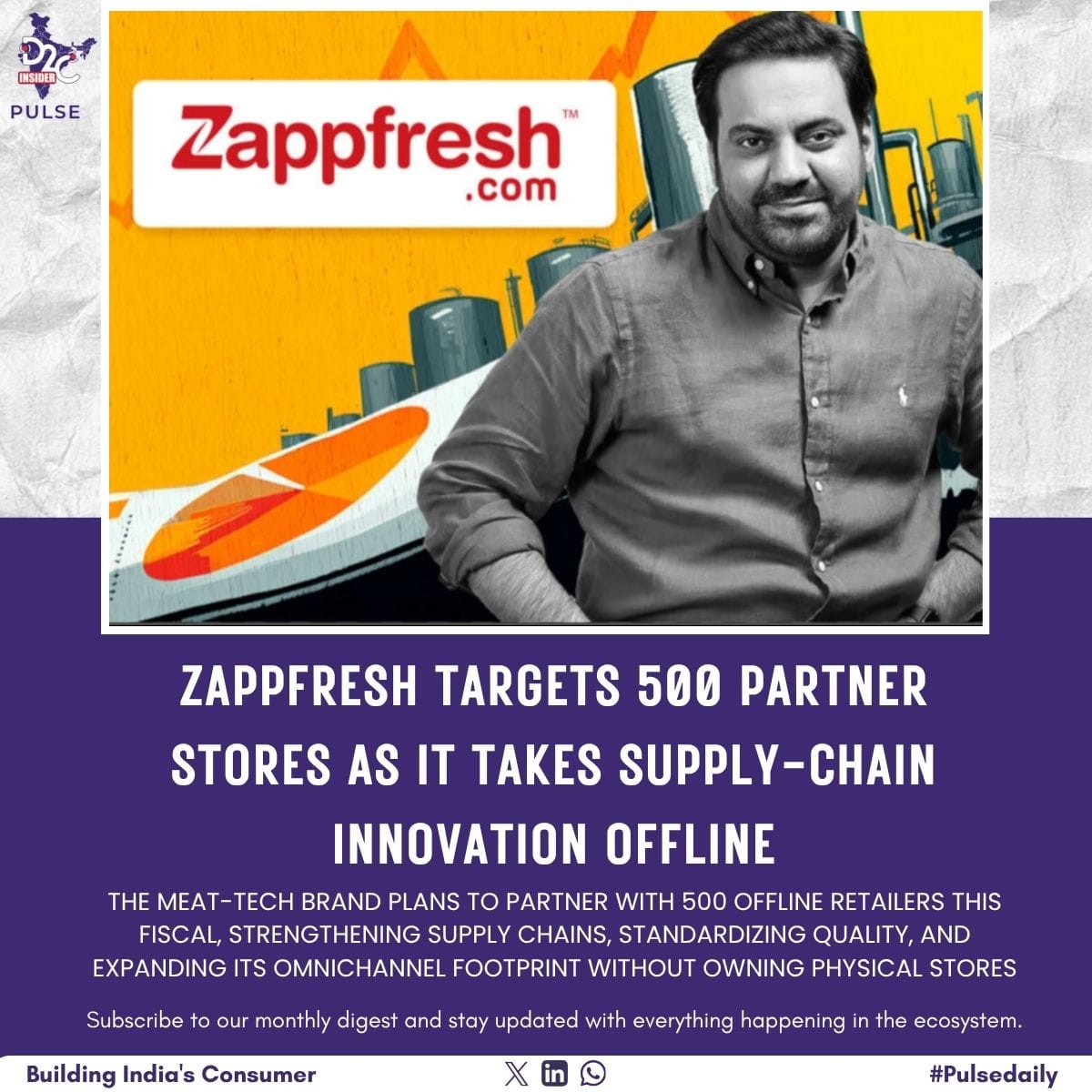
India’s meat retail market remains one of the country’s largest yet most fragmented consumer sectors, with nearly 95% of the estimated $55 billion market still unorganised. As demand for hygienic, high-quality meat products continues to rise, Zappfresh is betting that the biggest opportunity lies not in opening more stores, but in enabling thousands of existing neighbourhood retailers.
The company is targeting 500 partner meat shops during the current financial year, more than doubling its existing network of around 200 retail partners. Rather than pursuing a traditional retail expansion strategy, Zappfresh is building an asset-light, supply-chain enablement model that focuses on empowering independent meat retailers with products, infrastructure, and operational support.
The strategy is initially focused on strengthening market density in Mumbai and Bengaluru over the next one to two years before expanding into additional geographies. According to the company, building deeper local ecosystems is expected to create stronger operational efficiencies than rapid geographic expansion.
Under its partnership model, Zappfresh supplies products, standardises quality and pricing, expands assortment, and supports retailers with infrastructure such as refrigeration and hygiene upgrades. This allows partner stores to focus on customer engagement and sales while the company manages much of the backend supply-chain operations.
The company believes the industry’s biggest challenge lies in supply-chain inefficiencies rather than consumer demand. To help retailers increase revenue, Zappfresh also broadens their product assortment with ready-to-eat offerings and complementary products. While many traditional meat shops specialise in a single category such as chicken, fish, or mutton, the expanded assortment enables higher customer spending per visit.
Its portfolio currently spans nearly 150 SKUs, with assortments customised according to each retailer’s size and operating capacity. Partner selection is also carefully managed, with prospective merchants evaluated across more than 30 parameters, including business history, sales performance, market checks, and reference verification before onboarding.
The average partner store generates approximately ₹4–5 lakh in monthly revenue, while Zappfresh earns through product sales rather than revenue sharing, reinforcing its role as a supply-chain partner instead of a franchise operator.
The model also creates an efficient pathway for offline expansion without owning physical stores. Looking ahead, Zappfresh plans to selectively integrate its online proposition through chosen partner outlets once the merchant network reaches sufficient scale. Currently, around 70% of the company’s business comes from B2B operations, with the remaining contribution coming from direct consumer sales.
As organised food retail continues evolving, Zappfresh’s supply-chain-first approach highlights how technology, operational enablement, and strategic partnerships can modernise India’s highly fragmented meat retail ecosystem while creating scalable growth for both retailers and the brand.
Source: Based on publicly available reporting, with additional editorial adaptation and analysis.