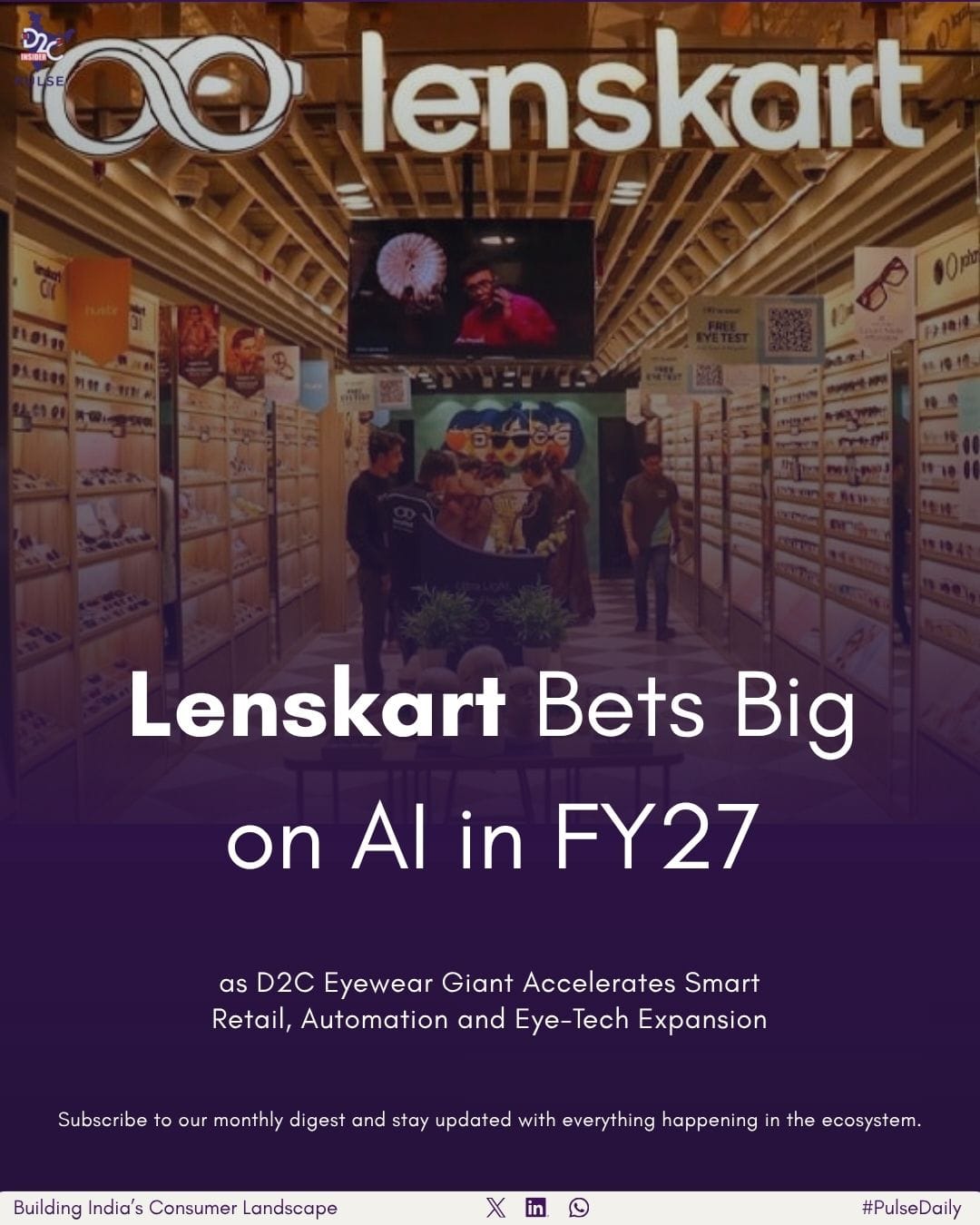
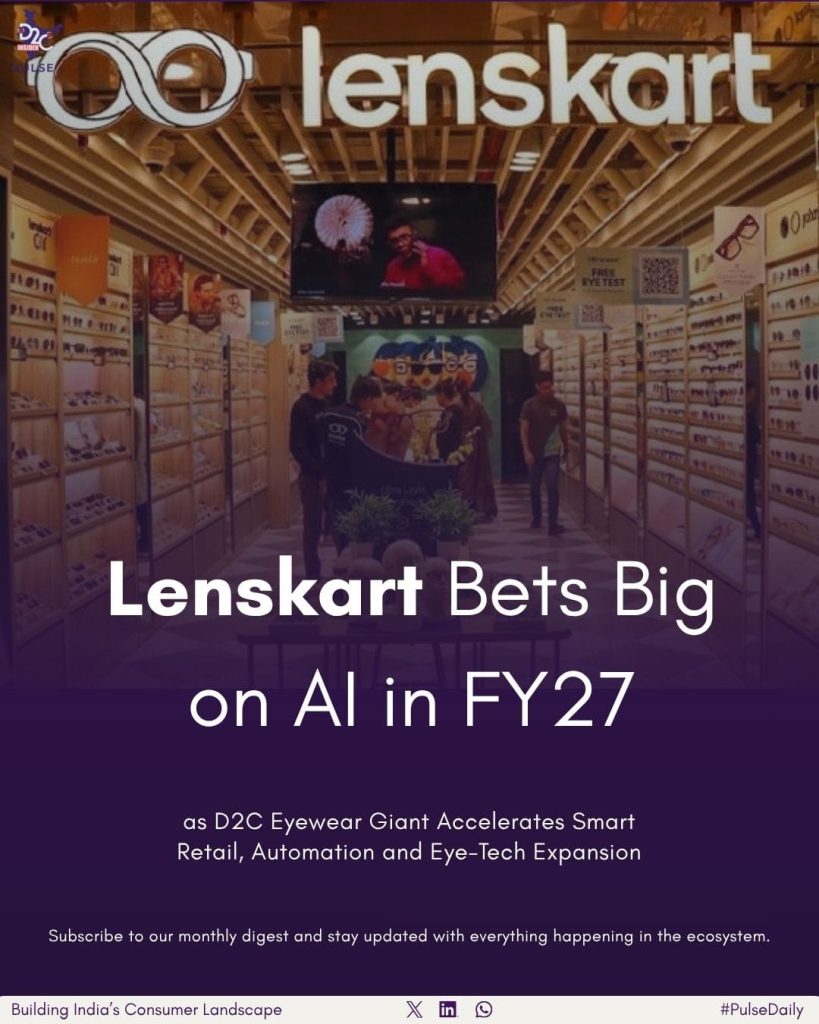
Lenskart is doubling down on artificial intelligence as it sharpens its next phase of growth across India and global markets. In one of the biggest technology-led shifts in the Indian D2C ecosystem India has seen, the eyewear giant is transforming itself from a consumer-tech company into what founder Peyush Bansal calls a “consumer-AI company,” placing AI at the center of its FY27 growth strategy.
The move marks a significant moment in D2C news India and highlights how some of the fastest-growing D2C brands are now integrating AI deeply into operations, customer experience, manufacturing, and product innovation. As part of its larger Direct-to-consumer India strategy, Lenskart plans to deploy AI across its entire value chain — from eye tests and product design to manufacturing, warehousing, delivery, and customer acquisition.
The Gurugram-based company said FY27 will focus heavily on sustainable scale, automation, omnichannel D2C strategy, and AI-powered efficiency. The announcement comes shortly after Lenskart reported strong Q4 FY26 performance, with revenue rising 46% year-on-year to Rs 2,516 crore. The company also posted a profit after tax of Rs 204 crore, reinforcing its leadership position within India’s rapidly evolving D2C business India landscape.
As part of its D2C expansion plans, Lenskart aims to dramatically scale eye-testing capacity using AI-enabled systems. The company currently conducts around 30 million eye tests and is targeting 100 million eye tests over the next few years. AI-powered remote eye testing, self-optometry, and automation tools are expected to play a major role in making vision care more accessible while improving optometrist productivity globally.
Peyush Bansal said the company’s biggest priority for FY27 is sustaining long-term growth through AI integration across every layer of the business. According to the company, eye-test data will increasingly shape product design, while social media and consumer trend signals will move directly into manufacturing in days instead of weeks. This reflects a major shift in D2C supply chain innovation and AI-led D2C go-to-market strategy.
Lenskart is also increasing investments in R&D and smart eyewear innovation. Its recently launched “B by Lenskart” AI-powered smart glasses have already attracted more than 30,000 customers to the waitlist. The company said smart eyewear remains a long-term opportunity, but the early consumer response reflects growing demand for AI-enabled lifestyle technology and premium D2C brands India.
The company’s omnichannel D2C strategy continues to expand aggressively. Lenskart added 603 net new stores in FY26, including 542 stores in India. Its stores are increasingly operating as multi-role neighborhood hubs that combine retail, eye testing, servicing, warehousing, and last-mile delivery. Next-day delivery is already available across 78 Indian cities, while same-day delivery has gone live in select markets including Gurugram and Singapore.
Lenskart also reiterated its long-term EBITDA margin expectation of around 25%, highlighting confidence in operational efficiency and scalable growth. The company said annual volume growth of around 25% would remain a strong indicator of underlying market expansion.
For India’s D2C industry news ecosystem, Lenskart’s AI-first strategy signals a broader transformation underway across D2C brands scaling in 2025. From automation and smart eyewear to AI-powered personalization and retail intelligence, the company is positioning itself at the intersection of technology, healthcare, and modern retail innovation.
As D2C market trends 2025 increasingly revolve around AI, automation, omnichannel commerce, and consumer experience, Lenskart is emerging as one of the top funded D2C brands driving the next evolution of the global consumer-tech and eyewear market.