
For India’s home-care brands, the challenge of building a large consumer business is no longer limited to developing sustainable alternatives or launching new products. It is about making those products available wherever consumers regularly shop, while competing with established FMCG companies on performance, pricing and accessibility.
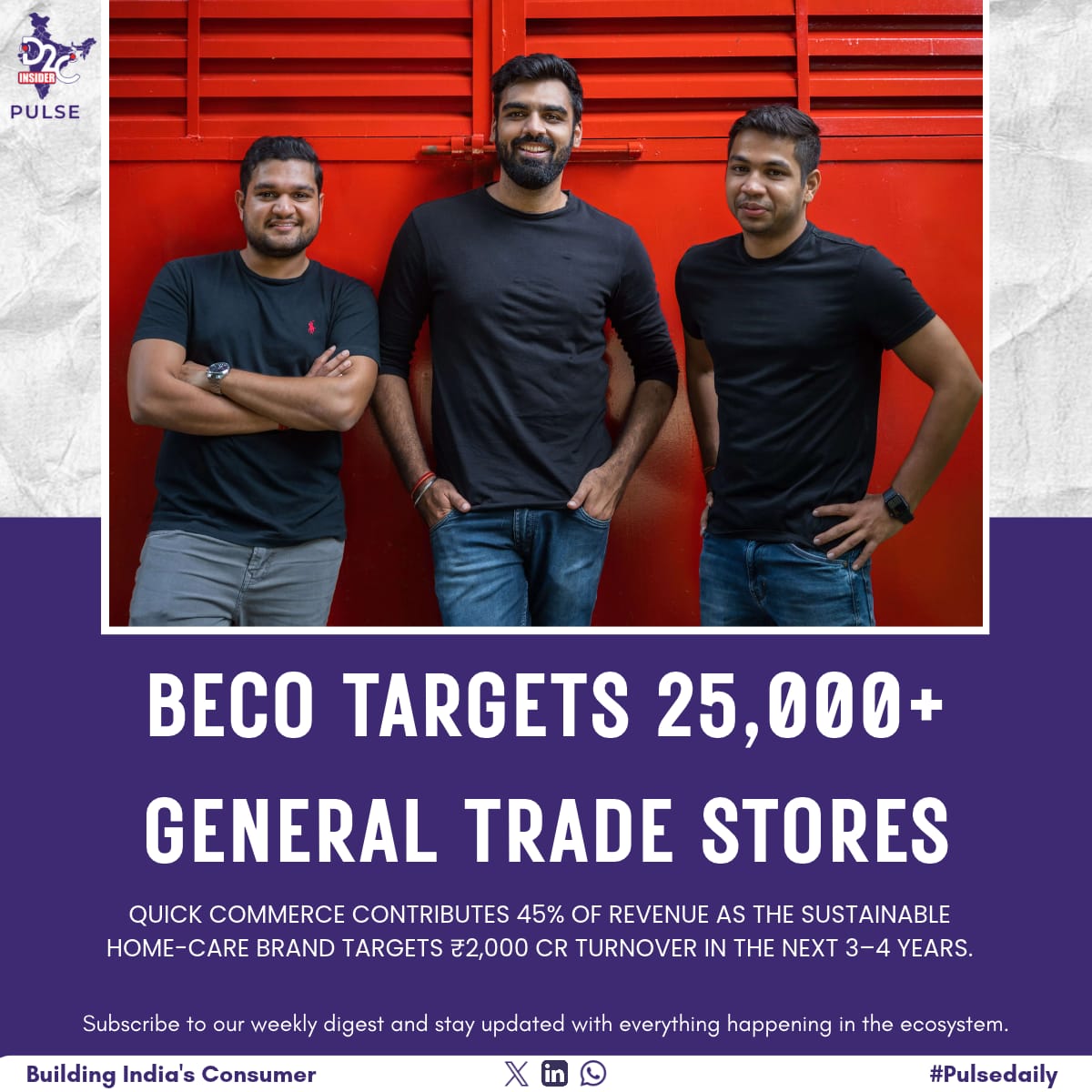
Mumbai-based Beco is attempting to build that scale through a combination of quick commerce and traditional retail. The home and personal care brand currently reaches approximately 5,000 general-trade stores across nine key markets and is targeting more than 25,000 outlets over the next two to three years. At the same time, quick commerce has emerged as one of its biggest growth channels, contributing approximately 45% of overall revenue, compared with 30% a year earlier.
Founded by Aditya Ruia, Anuj Ruia and Akshay Varma, Beco began with a focus on reducing plastic waste through alternatives such as bamboo-based tissues. It entered the market with bamboo tissues in 2019, expanded into garbage bags in 2020 and subsequently added home-cleaning products, including laundry liquids, floor cleaners and dishwash liquids.
The company’s current strategy reflects a broader ambition: moving sustainable household products beyond a niche consumer segment and into everyday Indian homes.
Quick commerce drives growth, offline remains the scale opportunity
Beco currently generates approximately 80% of its sales through online channels, with offline retail contributing the remaining 20%. Quick commerce alone accounts for around 45% of total revenue, making it a significant part of the company’s distribution mix.
The brand is present across platforms including Blinkit, Zepto, Swiggy Instamart, Flipkart Minutes and BigBasket. According to co-founder Akshay Varma, Beco is listed across approximately 90% of relevant dark stores and holds the number-two position in categories such as dishwash and floor cleaners on several quick-commerce platforms.
However, the company is looking beyond digital channels for its next phase of expansion.
Its general-trade network currently spans Mumbai, Delhi, Pune, Hyderabad, Chennai, Bengaluru, Chandigarh, Lucknow and Kochi. In modern trade, Beco has a presence in approximately 150 DMart stores and more than 250 Reliance Retail stores. It has also entered army canteens with four products.
Over the next two to three years, the company plans to expand its general-trade presence to more than 25,000 outlets, alongside selective expansion in modern trade. Tier II cities and rural markets are also emerging as important targets for increasing household penetration.
Performance and pricing remain central to adoption
For Beco, sustainability is only one part of its product proposition. The company believes consumers will not compromise on cleaning performance simply to choose an environmentally positioned product. Competitive pricing and availability are equally important.
This is particularly challenging in categories such as laundry detergents and dishwashing liquids, where established brands including Surf Excel and Vim have strong consumer recall and extensive distribution networks.
Laundry liquid currently contributes approximately 33–34% of Beco’s sales. Its reusable bamboo kitchen towel is another important product, generating approximately ₹7 crore in revenue, according to Varma.
The company is also investing in product development and manufacturing control. Its formulations and research and development are managed in-house, while production combines its own tissue manufacturing facility in Maharashtra with third-party manufacturing partnerships. Approximately 80% of its tissue production takes place at its own facility.
The ₹2,000 crore ambition
Beco’s expansion plans are backed by a larger financial ambition. The company is targeting ₹2,000 crore in turnover over the next three to four years and aims to become a leading player in categories such as dishwashing, floor cleaning and laundry care. It is also targeting a 15–20% market share across these categories, according to Varma. The founders have additionally expressed an ambition to take the company public within the next three years.
The scale of this ambition becomes clearer against its last publicly reported financial performance. Beco recorded approximately ₹108 crore in revenue in FY25, compared with ₹49.37 crore in FY24. However, it reported a net loss of around ₹21.7 crore in FY25, highlighting the financial challenge that accompanies rapid expansion.
The next phase will therefore require the company to balance distribution growth with stronger operating economics. Expanding from 5,000 to 25,000 general-trade outlets will involve investments in inventory, retailer relationships, supply-chain capabilities and market-level execution.
For Beco, quick commerce may have accelerated product discovery and contributed significantly to revenue growth, but traditional retail remains central to its ambition of becoming a mainstream home-care brand. Its ability to make sustainable products perform competitively, remain affordable and stay consistently available will determine whether that ambition can translate into lasting market share.
Sources: Indian Retailer, Inc42, The Economic Times and publicly available company information.