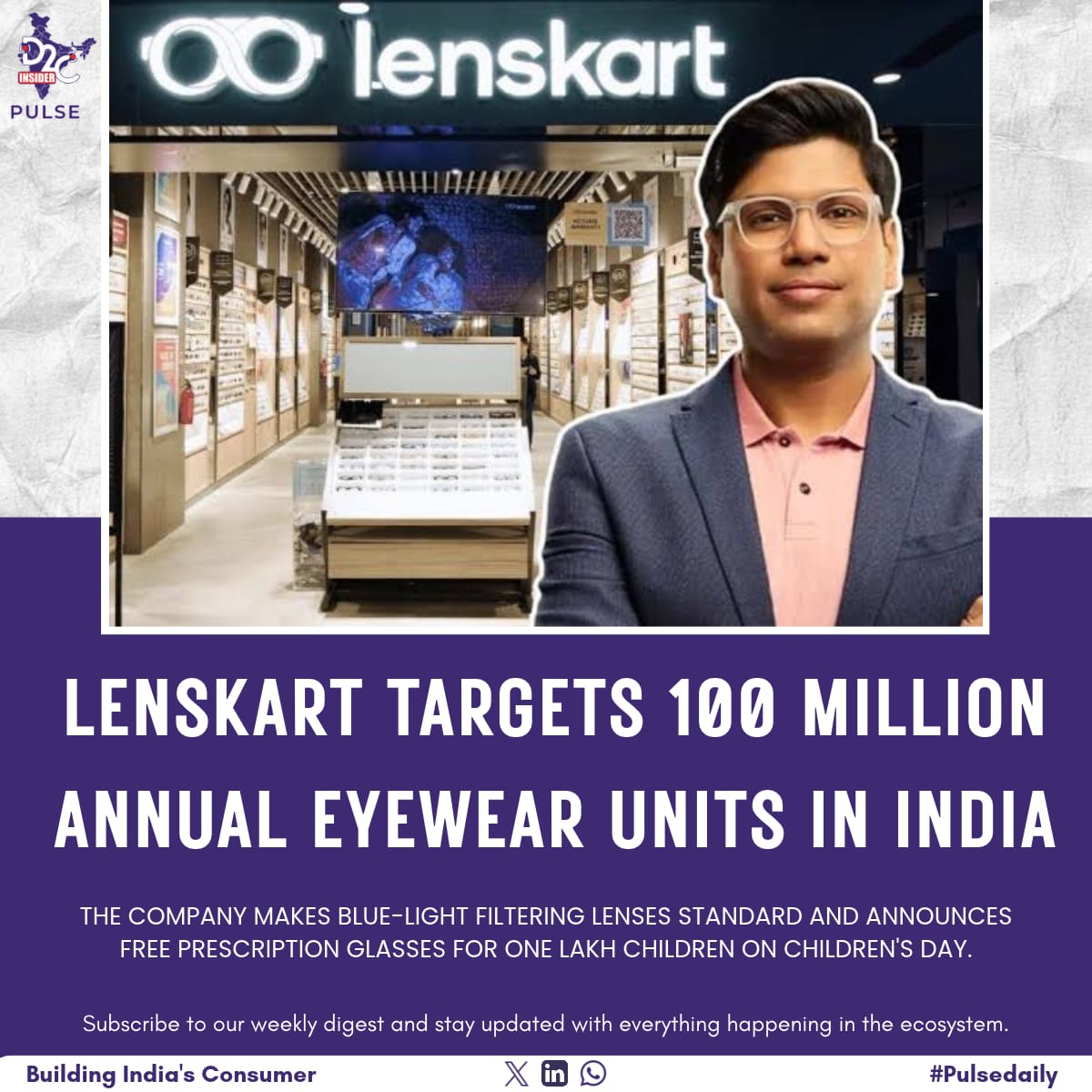
Lenskart is setting its sights on a significantly larger share of India’s eyewear market, targeting annual volumes of 100 million units in the country, up from the 32 million units it currently serves. The ambition comes as the company looks to make vision correction more accessible through lower-cost products, wider distribution and initiatives focused on children’s eye care.
Co-founder and CEO Peyush Bansal outlined the target while marking the first anniversary of Lenskart’s stock market listing. Alongside the growth ambition, the company announced two initiatives aimed at reducing the cost of eyewear for Indian consumers: making blue-light filtering lenses standard on its glasses in India and providing prescription eyewear to one lakh children on Children’s Day, November 14.
The announcements reflect a broader shift in how Lenskart is positioning its next phase of growth. Rather than measuring its progress only through revenue and business expansion, the company is placing greater emphasis on increasing access to affordable vision care.
Making eyewear more accessible
Effective November 12, Lenskart has made blue-light filtering lenses a standard feature on eligible glasses in India, without charging customers an additional amount. The feature was previously offered as an optional upgrade, meaning customers had to pay extra to include it.
The move removes an additional purchase decision for consumers and makes the feature accessible across a wider section of its customer base. However, the company has acknowledged that the scientific evidence surrounding the benefits of blue-light filtering remains debated. Its decision is therefore primarily positioned as a customer-accessibility measure rather than a claim of established medical benefit.
The second initiative focuses on children. On November 14, Lenskart will provide free prescription glasses, including frames and blue-light filtering lenses, to the first 100,000 eligible children aged five to 12 placing orders at participating stores across India. Families will need to pay ₹199 towards fitting charges.
Children aged eight to 12 can also access a free eye test at participating stores. For children below eight, a prescription from an eye doctor will be required.
The initiative highlights an important gap in India’s vision-care ecosystem, where undetected eyesight problems can affect children’s learning and everyday activities. By reducing the upfront cost of prescription eyewear, Lenskart is attempting to make early intervention more accessible.
A larger growth ambition backed by scale
The 100-million-unit target builds on Lenskart’s expanding business and manufacturing capabilities. In Q2 FY27, the company reported consolidated revenue of ₹2,845 crore, up 32.5% year-on-year, while profit after tax more than doubled to ₹232 crore.
Its India business generated ₹1,668 crore in quarterly revenue, growing 35.3% year-on-year. The company added 143 net new stores in India during the quarter, taking its domestic network to 2,868 stores across 665 cities. It also conducted 80 lakh eye tests globally during the quarter, reflecting the growing role of vision-care services alongside eyewear retail.
Manufacturing is another important part of the strategy. Lenskart has been expanding its in-house frame and lens manufacturing capabilities to improve cost control, product quality and supply-chain efficiency. Its upcoming Hyderabad manufacturing facility is expected to strengthen capacity as the company pursues its next phase of growth.
Bansal has also reiterated the company’s broader ambition of helping one billion people see clearly. Moving from 32 million to 100 million annual eyewear units in India will require more than expanding store numbers. Affordability, awareness, access to eye testing and the ability to deliver prescription eyewear at scale will all play a role.
For Lenskart, the next phase is about using its growing business infrastructure to address a much larger vision-care opportunity. Whether it can reach 100 million annual units while maintaining affordability and operational efficiency will be an important measure of its long-term growth.
Sources: Fortune India, The Economic Times, Lenskart Q2 FY27 shareholder letter and NSE filings.