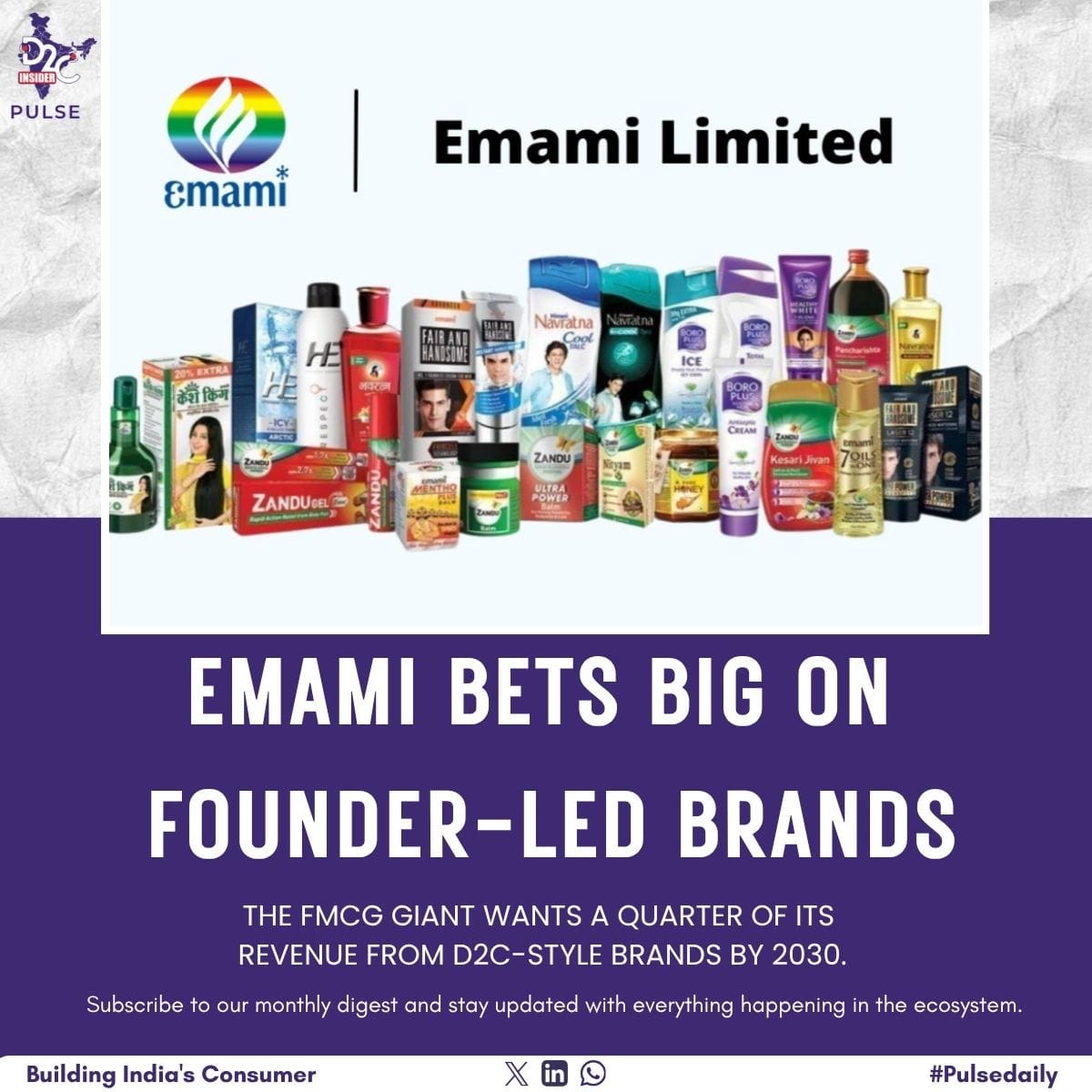
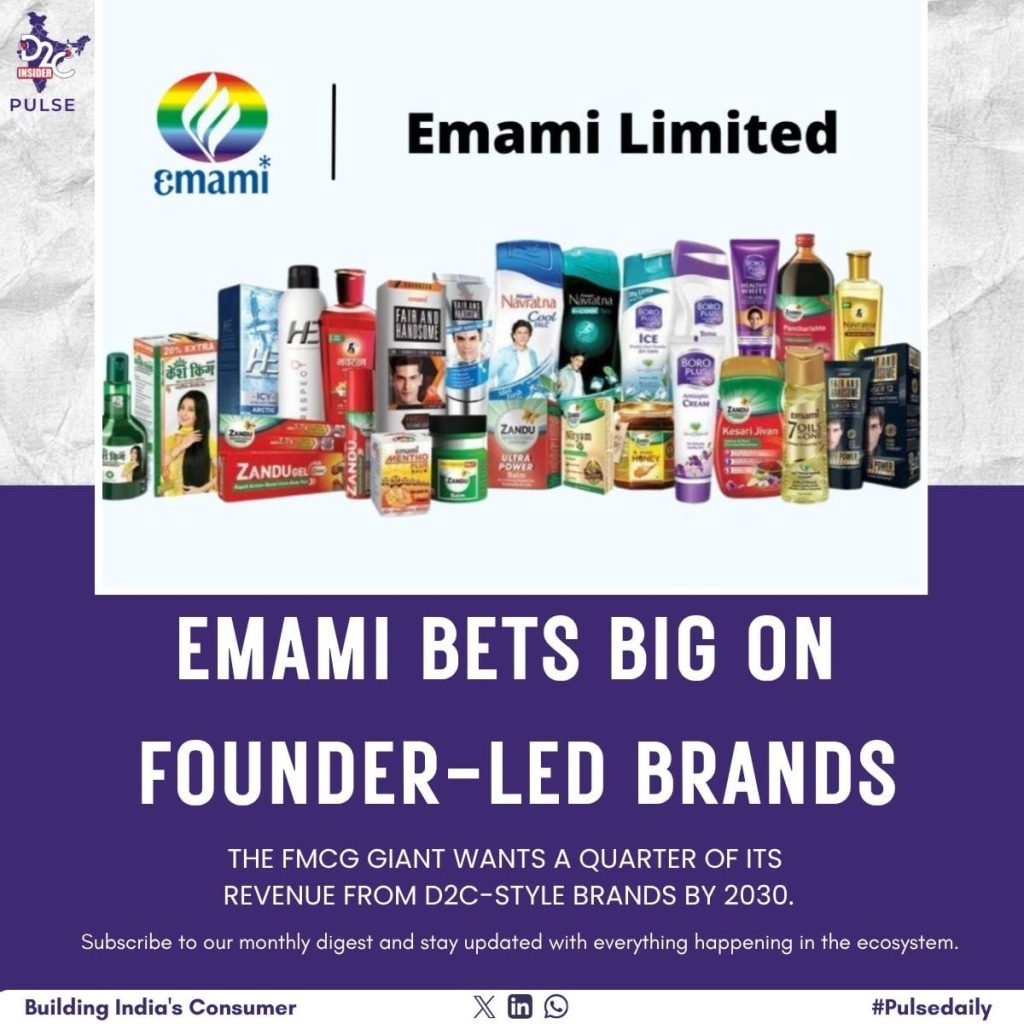
Emami Ltd has laid out a formal target to grow revenue from new-age and founder-led consumer brands to roughly 25% of consolidated turnover by FY29-30, up sharply from about 6% today.
Vice Chairman and Managing Director Harsha Vardhan Agarwal detailed the plan, which centres on a newly created “new-age business” vertical based in Gurgaon dedicated to identifying, investing in and scaling high-potential D2C startups. The model is a dual-engine one: steady cash flows from Emami’s legacy brands like Boroplus and Navratna fund the growth of newer, digitally-discovered, premium and wellness-focused businesses. Rather than acquiring outright on day one, Emami typically invests early and progressively increases its stake to full ownership as a brand scales.
The strategy is already in motion. In FY27, Emami took a 60% stake in IncNut Digital, owner of personalised haircare and skincare brands Vedix and SkinKraft, and acquired Axiom Ayurveda, maker of the functional beverage brand AloFrut. New-age and mainstream growth brands together now make up 21% of Emami’s domestic business in FY26, up from just 7% in FY20 — evidence the shift is already underway, not just aspirational.
“That financial discipline is not incidental; it is what allows us to act as a consolidator of choice for India’s most promising founder-led consumer brands,” Agarwal said, adding that the approach is “a genuine value-creation model, not a portfolio diversification exercise.”
The pitch to founders is straightforward: Emami’s nationwide general trade, modern trade and quick-commerce distribution, along with existing manufacturing capacity, can take a promising but distribution-constrained D2C brand and scale it faster than the founding team could alone — while founders get to keep building rather than fundraising indefinitely. It’s a model legacy FMCG players like Marico, HUL and ITC have also leaned into recently, but Emami’s stated 25% target gives the strategy an unusually explicit, trackable number.
For India’s D2C ecosystem, Emami’s move is a signal that legacy FMCG conglomerates are shifting from occasional bolt-on acquisitions to a structured, repeatable playbook for absorbing founder-led brands — giving scaling D2C startups a credible acquirer with distribution reach that’s hard to build organically.
Source: Based on reporting by BestMediaInfo, with additional editorial adaptation and analysis.