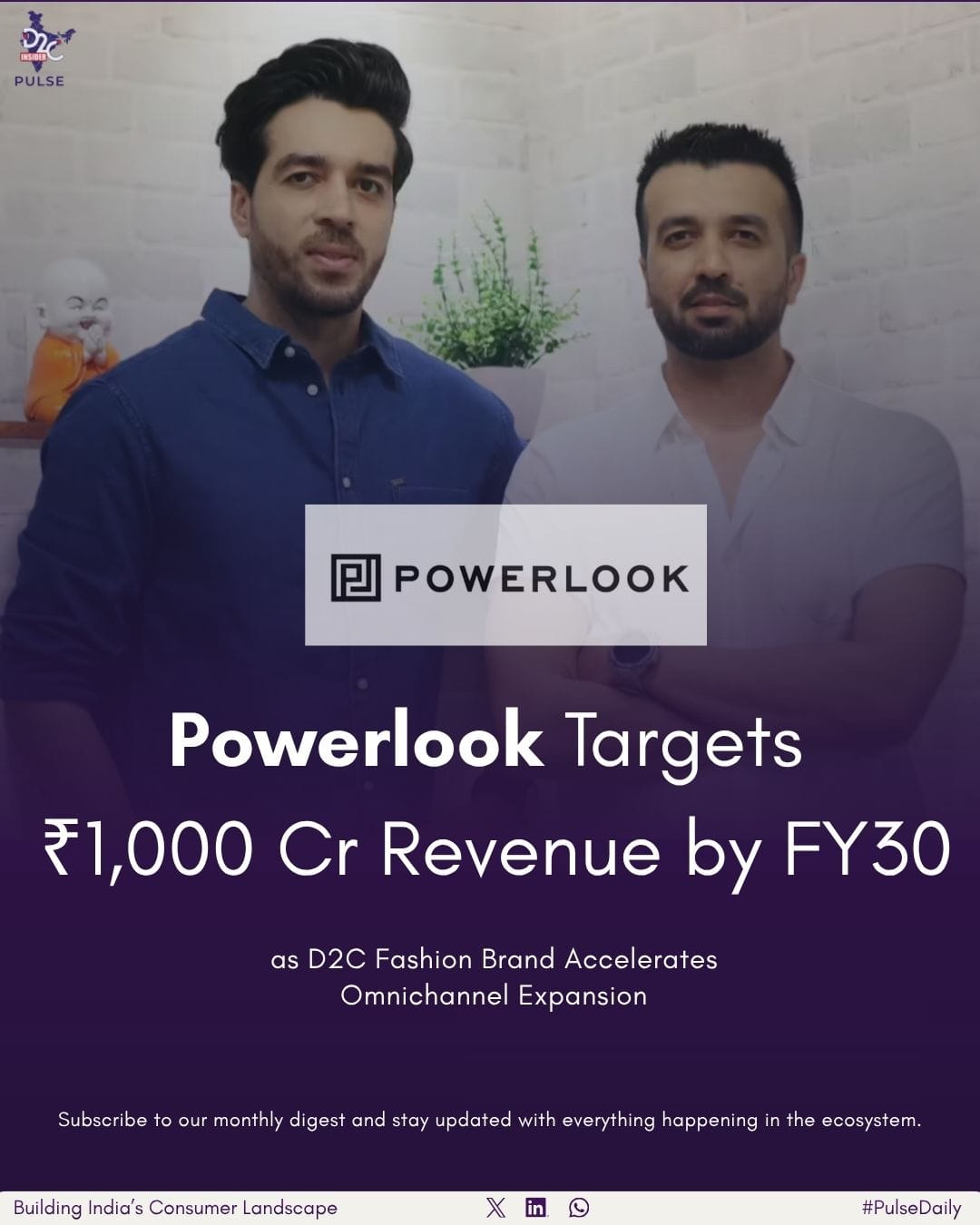
India’s fast-fashion landscape continues to witness strong momentum, and homegrown D2C fashion brand Powerlook is emerging as one of the notable growth stories in the evolving Direct-to-Consumer India ecosystem. As demand for affordable, trend-driven fashion continues to rise among young consumers, the Mumbai-based brand is now preparing for its next phase of expansion with ambitious revenue, retail, and omnichannel growth plans.
Powerlook has announced its intention to reach ₹800–1,000 crore in revenue by FY30, underscoring the scale of opportunity available within India’s rapidly expanding D2C fashion and lifestyle market. The development adds to the growing stream of D2C news India, D2C startup news, and Indian D2C updates highlighting how digitally native brands are increasingly building strong omnichannel businesses across the country.
The company closed FY26 with a net revenue of ₹175 crore and currently operates 13 stores. As part of its broader D2C expansion plans, Powerlook aims to scale its retail footprint aggressively, targeting more than 50 stores by FY28 and over 100 stores by FY30. The planned expansion will focus on major metropolitan markets including Mumbai, Delhi-NCR, Bengaluru, Hyderabad, Pune, and Chennai, while also strengthening presence across high-potential Tier-II cities such as Ahmedabad, Jaipur, Lucknow, Indore, Nagpur, Chandigarh, and Surat.
The expansion reflects broader D2C market trends 2025, where leading D2C brands India are increasingly adopting an omnichannel D2C strategy to combine the strengths of ecommerce and offline retail. While the brand initially built its presence through digital channels, it now sees physical retail as a critical lever for consumer acquisition, brand building, and long-term growth.
To support this growth, Powerlook plans to invest approximately ₹40–50 crore in retail infrastructure, store development, inventory, marketing, and operational capabilities. The company is currently evaluating multiple financing options, including debt, equity, or a combination of both. This makes the brand one to watch in future D2C funding news, D2C funding rounds, and D2C investor insights conversations as it explores capital to fuel expansion.
Alongside store growth, Powerlook is investing heavily in technology, warehouse automation, omnichannel fulfilment, and inventory management systems. These initiatives align closely with emerging D2C supply chain innovation trends, where brands are leveraging technology-driven decision-making to improve customer experience and operational efficiency.
The company is also expanding beyond apparel into adjacent categories such as footwear, accessories, innerwear, and athleisure. This category diversification strategy reflects changing D2C consumer behavior India, where shoppers increasingly prefer brands that offer a complete lifestyle ecosystem rather than standalone product categories.
Powerlook’s long-term roadmap extends beyond revenue growth. The brand is actively building institutional capabilities, strengthening data analytics, personalization, and operational processes while preparing for potential capital market participation by FY30. As discussions around D2C IPO news, Direct-to-Consumer startup IPO tracker, and D2C startup valuation continue to gain traction, Powerlook appears focused on creating a scalable and future-ready business.
The company’s journey highlights a larger shift taking place across the D2C ecosystem India. Today’s fastest-growing D2C brands are no longer relying solely on online sales. Instead, they are building integrated businesses that combine strong brand identity, omnichannel distribution, technology-led operations, and customer-centric innovation.
With a clear growth roadmap, expanding retail presence, category diversification, and ambitions to reach ₹1,000 crore revenue by FY30, Powerlook is positioning itself as one of the D2C brands scaling in 2025 and beyond. As India’s D2C business landscape continues to evolve, the brand’s expansion strategy reflects the growing maturity and potential of the country’s next generation of fashion-led consumer brands.