
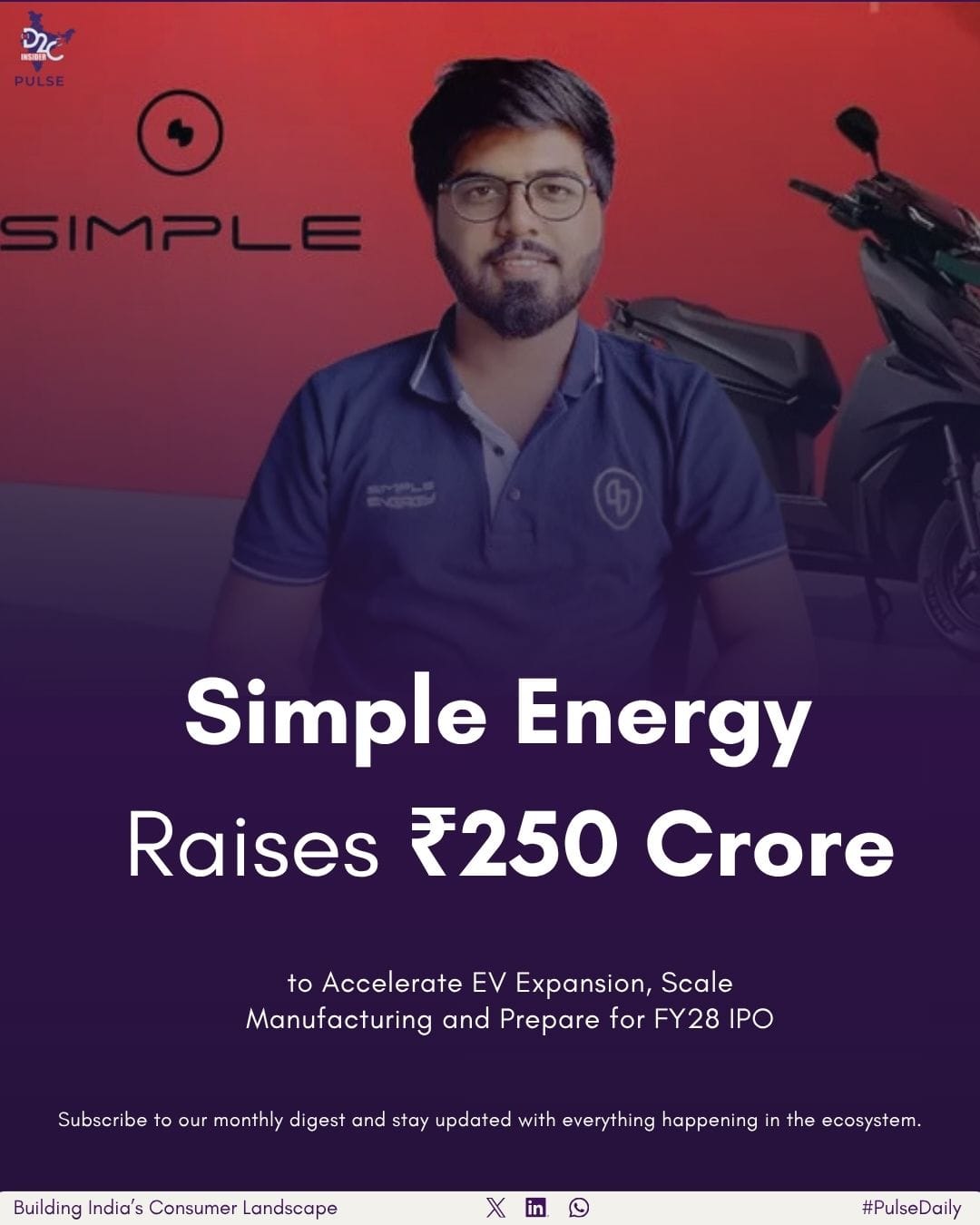
For anyone tracking D2C news India, D2C startup news, and the latest developments in India’s consumer and mobility landscape, Simple Energy’s latest fundraise marks another significant milestone in the growth story of new-age Indian brands. The Bengaluru-based electric two-wheeler company has raised ₹250 crore through a mix of equity and debt funding, reinforcing investor confidence in the rapidly expanding electric mobility ecosystem and highlighting the growing momentum behind innovation-led Indian consumer brands.
The funding round was led by the family office of Arokiaswamy Velumani, Founder of Thyrocare Technologies, with participation from the founders of Simple Energy. Debt financing contributed ₹123 crore and was provided by HDFC Bank, Capitar Ventures, and other NBFCs. The fresh capital comes at a crucial stage in the company’s growth journey as it focuses on scaling manufacturing, strengthening distribution, accelerating product development, and preparing for a planned public market debut.
Founded in 2019 by Suhas Rajkumar and Shreshth Mishra, Simple Energy has emerged as one of the most closely watched names among India’s new-age mobility brands. The company designs and manufactures high-performance electric scooters, with its flagship model offering a claimed range of up to 248 kilometres on a single charge, a top speed of 105 kmph, and one of the largest storage capacities in its category.
The latest funding round aligns closely with broader D2C funding news, D2C expansion plans, and Indian D2C updates, showcasing how capital is increasingly flowing toward technology-driven brands that combine manufacturing, innovation, and direct consumer engagement. A significant portion of the newly raised capital will be used to expand production capacity and manufacturing infrastructure. The remaining funds will support sales, marketing, customer acquisition, research and development, and future product innovation.
Simple Energy plans to increase production from approximately 3,000 scooters per month to 10,000 scooters by January, followed by a further increase to 15,000 scooters per month by March next year. The company currently sells around 2,000 scooters every month and intends to significantly strengthen its market presence through a wider retail and distribution network.
As part of its aggressive growth strategy, the company plans to expand from nearly 80 retail outlets today to between 200 and 250 stores by next March. This expansion reflects larger D2C market trends 2025, where brands are increasingly adopting an omnichannel D2C strategy, blending physical retail with digital engagement to improve customer reach and experience.
The company’s financial performance also reflects strong momentum. Simple Energy expects to report operating revenue of approximately ₹150–160 crore in FY26, compared to nearly ₹40 crore in FY25, representing close to fourfold growth. Such rapid scaling places the company among the fastest-growing D2C brands and emerging consumer technology businesses in India.
Looking ahead, Simple Energy is preparing for a potential IPO in the second half of FY28, with plans to raise nearly ₹3,000 crore ($350 million). The proposed public offering will support market expansion, advanced research and development initiatives, and the establishment of a new manufacturing facility. The development is likely to attract attention from investors closely tracking D2C IPO news, D2C business India, VC-backed D2C brands, and the future of India’s consumer technology sector.
As India’s electric mobility market continues to expand, Simple Energy’s latest funding round demonstrates how innovation, manufacturing excellence, and consumer-focused product development can create powerful growth opportunities. The company’s ambitious expansion roadmap, strengthening retail footprint, and IPO aspirations position it as a brand to watch within India’s evolving startup ecosystem and next-generation consumer economy.